
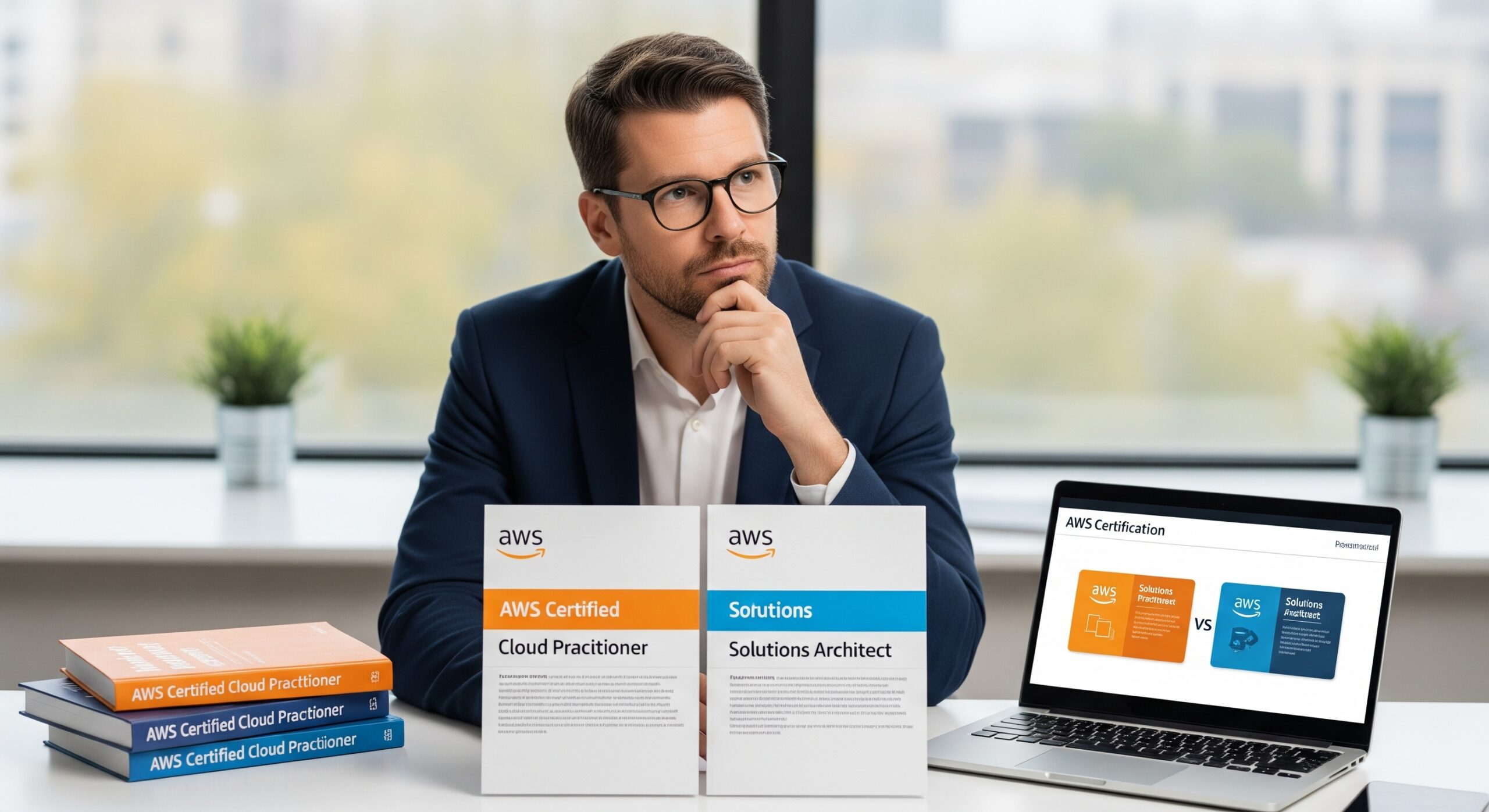
AWS Certified Cloud Practitioner vs Solutions Architect: Which Path Should You Choose?
AWS Certified Cloud Practitioner vs Solutions Architect. In today’s rapidly evolving tech world, cloud computing stands as the backbone of modern digital innovation. As businesses rush to leverage cloud platforms for scalability, security, and efficiency, the demand for skilled professionals has skyrocketed. Among the various AWS certifications, two titles often spark curiosity and sometimes confusion: AWS Certified Cloud Practitioner and AWS Certified Solutions Architect. Which one suits your career goals? How do they differ in scope, skills, and real-world application? If you’ve ever pondered these questions, you’ve landed in the right place.
This article dives deep into the distinctions between these two coveted certifications, offering a clear roadmap for aspiring cloud professionals. Whether you’re starting fresh or aiming to enhance your cloud expertise, understanding these roles is essential for making an informed choice.
Understanding the AWS Certified Cloud Practitioner Role
The AWS Certified Cloud Practitioner certification represents an entry-level credential designed to validate foundational cloud knowledge. This certification targets individuals who want to understand AWS basics without necessarily diving into architectural or technical intricacies. It provides a broad overview of AWS cloud concepts, services, security, pricing, and support. Consequently, it suits business managers, sales professionals, and newcomers who want to familiarize themselves with cloud computing principles.
At its core, this certification establishes a firm grasp of the AWS ecosystem. It emphasizes concepts such as the shared responsibility model, global infrastructure, billing and pricing models, and basic architectural principles. Unlike deeper technical certifications, it does not require hands-on experience or in-depth coding knowledge, making it accessible to those outside traditional IT roles.
Exploring the AWS Certified Solutions Architect Profession
In contrast, the AWS Certified Solutions Architect—especially the Associate level—targets individuals who design and deploy scalable systems on AWS. This certification demands a deeper understanding of AWS services and architecture best practices. Professionals holding this credential demonstrate expertise in building secure, cost-effective, and resilient cloud environments tailored to business needs.
Solutions architects often bridge the gap between business requirements and technical execution. They assess customer needs, design cloud architectures, and provide guidance on best practices to optimize performance and security. Their skill set includes deploying compute resources, designing storage solutions, implementing networking, and ensuring fault tolerance.
In essence, while the Cloud Practitioner certification offers a broad cloud overview, the Solutions Architect certification demands practical design and implementation skills for complex cloud infrastructures.
Essential Skills for AWS Certified Cloud Practitioner
AWS Certified Cloud Practitioner vs Solutions Architect. Candidates preparing for the Cloud Practitioner exam should focus on understanding fundamental cloud concepts. This involves grasping AWS core services like Amazon EC2, S3, and RDS in simple terms. Equally important is comprehending security basics, including identity and access management (IAM), encryption, and compliance frameworks.
Furthermore, knowledge about pricing structures and billing management helps individuals understand cost optimization strategies. This insight is vital for roles that interact with AWS financially or strategically without necessarily deploying cloud resources.
Effective communication skills also matter since many Cloud Practitioners act as liaisons between technical teams and business stakeholders. Being able to explain cloud concepts clearly helps foster collaboration across departments.
Vital Competencies for AWS Certified Solutions Architect
On the other hand, Solutions Architects need a robust technical foundation. They should master AWS compute options like EC2 instance types, serverless technologies such as AWS Lambda, and container services like Amazon ECS and EKS. Networking skills including VPC design, routing, and security groups are equally crucial.

Additionally, architects must implement high availability by leveraging multi-AZ deployments, load balancers, and disaster recovery solutions. Security proficiency encompasses configuring IAM roles, encryption at rest and in transit, and applying AWS security best practices to safeguard infrastructure.
Problem-solving abilities remain paramount. Architects constantly evaluate trade-offs between cost, performance, and reliability to recommend optimal cloud solutions tailored to client requirements.
Learning Path for AWS Certified Cloud Practitioner
AWS Certified Cloud Practitioner vs Solutions Architect. Embarking on the Cloud Practitioner journey usually begins with exploring AWS’s foundational documentation and free online resources. AWS offers official training videos, whitepapers, and practice exams that guide learners through essential topics.
Many newcomers find value in introductory courses available on platforms like Coursera, Udemy, and A Cloud Guru, which focus on fundamental cloud literacy without overwhelming technical detail. The hands-on experience can be supplemented by creating a free-tier AWS account to experiment with core services practically.
Since the exam covers broad conceptual knowledge, consistent review and understanding of AWS FAQs, pricing calculators, and support models prove beneficial. In a few weeks of dedicated study, most candidates feel confident to attempt the exam.
Learning Journey for AWS Certified Solutions Architect
Preparing for the Solutions Architect certification requires a more structured and immersive learning experience. Candidates typically start by understanding the AWS Well-Architected Framework, which guides the design of secure and efficient architectures.
Hands-on labs and projects play a vital role in reinforcing theoretical knowledge. Utilizing AWS Free Tier resources or sandbox environments helps in practicing tasks like launching EC2 instances, configuring S3 buckets, or setting up VPCs.
Advanced training courses emphasize scenario-based learning, where candidates solve real-world problems such as optimizing workloads or designing multi-tier applications. This approach sharpens critical thinking and technical application.
Exam preparation involves rigorous practice tests that simulate the complex question style emphasizing architectural trade-offs, compliance requirements, and fault tolerance. This certification path often takes several months, reflecting its depth and complexity.
Tools and Technologies Used by Cloud Practitioners
AWS Certified Cloud Practitioner vs Solutions Architect. While Cloud Practitioners may not dive deep into AWS tools, understanding core interfaces such as the AWS Management Console is essential. The console provides a graphical interface for managing AWS resources, making it easier for beginners to navigate services.
Moreover, tools like AWS Pricing Calculator and AWS Trusted Advisor help practitioners evaluate cost and security recommendations. Although the Cloud Practitioner role does not demand coding skills, familiarity with basic command-line interfaces or SDKs can enhance understanding.
Collaboration platforms such as AWS CloudFormation might be introduced at a high level to understand infrastructure as code principles without hands-on deployment.
Technologies and Instruments for Solutions Architects
Solutions Architects wield a broader set of technical tools. Mastery of the AWS CLI enables automation and efficient resource management. Infrastructure as Code tools like AWS CloudFormation or Terraform empower architects to define and provision cloud infrastructure reliably.
Understanding monitoring and logging tools such as Amazon CloudWatch and AWS Config allows architects to maintain operational health and compliance. In addition, familiarity with security tools like AWS Identity and Access Management (IAM) policies, AWS Key Management Service (KMS), and AWS Shield enhances protection strategies.
Advanced architects often integrate third-party tools for continuous integration and delivery (CI/CD) pipelines, leveraging AWS CodePipeline and CodeBuild to streamline deployments.
Gaining Real-World Experience as a Cloud Practitioner
Practical experience for Cloud Practitioners often comes from observing and supporting cloud projects in non-technical roles. For example, participating in budgeting discussions about AWS costs or assisting sales teams with cloud service explanations provides valuable context.
Experimenting with AWS Free Tier services encourages hands-on exploration without the pressure of technical mastery. This experience helps translate theoretical concepts into observable cloud behaviors, building confidence and insight.
Engaging with community forums, webinars, and workshops also supplements learning, connecting practitioners with industry trends and peer experiences.
Hands-On Experience for Solutions Architects
Solutions Architects thrive through immersive, project-driven work. Real-world challenges involve designing fault-tolerant systems, migrating applications to AWS, and optimizing workloads for cost and performance.
Collaborating with developers, security teams, and business stakeholders enhances cross-functional communication and solution alignment. Architects frequently troubleshoot production environments, learning to anticipate and mitigate risks proactively.
Participating in hackathons, open-source projects, or cloud-focused internships accelerates skill acquisition. Continuous experimentation with new AWS features keeps architects ahead of evolving technology landscapes.
Career Tips for Aspiring AWS Cloud Practitioners
AWS Certified Cloud Practitioner vs Solutions Architect. Starting as a Cloud Practitioner offers a gateway into the cloud industry. Building foundational knowledge before advancing to technical roles ensures a solid understanding of business impacts.
Networking with AWS professionals and joining user groups broadens exposure to cloud career pathways. Pursuing complementary certifications such as AWS Certified Developer or AWS Certified SysOps Administrator can facilitate career growth.
Regularly updating knowledge about AWS service updates and cloud trends maintains relevance in a fast-changing environment.
Career Guidance for Future Solutions Architects
For those aiming to become Solutions Architects, gaining diverse technical expertise is vital. Pursuing certifications beyond the Associate level, such as the Professional Solutions Architect, enhances credibility and career prospects.
Developing soft skills like project management, leadership, and customer engagement proves valuable as architects often lead cross-team initiatives. Attending conferences and contributing to cloud communities builds professional reputation.
Emphasizing continuous learning through online courses, certifications, and practical projects sustains growth in this competitive field.
Common Mistakes to Avoid When Choosing Your AWS Certification Path
Many beginners rush into advanced certifications without mastering foundational knowledge, leading to frustration. Skipping the Cloud Practitioner step can result in gaps in cloud basics, affecting long-term success.
Overlooking hands-on practice undermines theoretical learning, especially for Solutions Architects where practical skills are critical. Neglecting soft skills and communication also limits career advancement opportunities.
Finally, ignoring updates in AWS services and exam blueprints can lead to outdated preparation, reducing exam success chances.
Conclusion: Choosing Between AWS Certified Cloud Practitioner and Solutions Architect
AWS Certified Cloud Practitioner vs Solutions Architect. Ultimately, selecting between AWS Certified Cloud Practitioner and Solutions Architect depends on your current experience, career goals, and interest level. The Cloud Practitioner certification offers a broad introduction ideal for business professionals and newcomers. It establishes essential cloud literacy that supports further specialization.
Conversely, the Solutions Architect certification demands deeper technical knowledge and practical skills for designing complex AWS environments. It suits individuals targeting hands-on cloud engineering and architecture roles.
By understanding the distinctions, skill requirements, and learning paths, you can confidently chart your AWS certification journey. Both certifications open doors to exciting opportunities in the thriving cloud industry, provided you commit to continuous learning and real-world application.
For more insights, visit the ClayDesk Blog: https://blog.claydesk.com