

The 5 Pillars of Ethical AI: Fairness, Transparency, Privacy, Accountability, Safety
Introduction
The 5 Pillars of Ethical AI, In 2025, artificial intelligence (AI) has become deeply woven into daily life, from personalized recommendations on streaming platforms to autonomous decision-making in healthcare, finance, and government services. As AI systems grow more powerful, ensuring their ethical use is no longer optional—it is a necessity. Ethical AI safeguards trust, promotes fairness, and mitigates unintended harms.
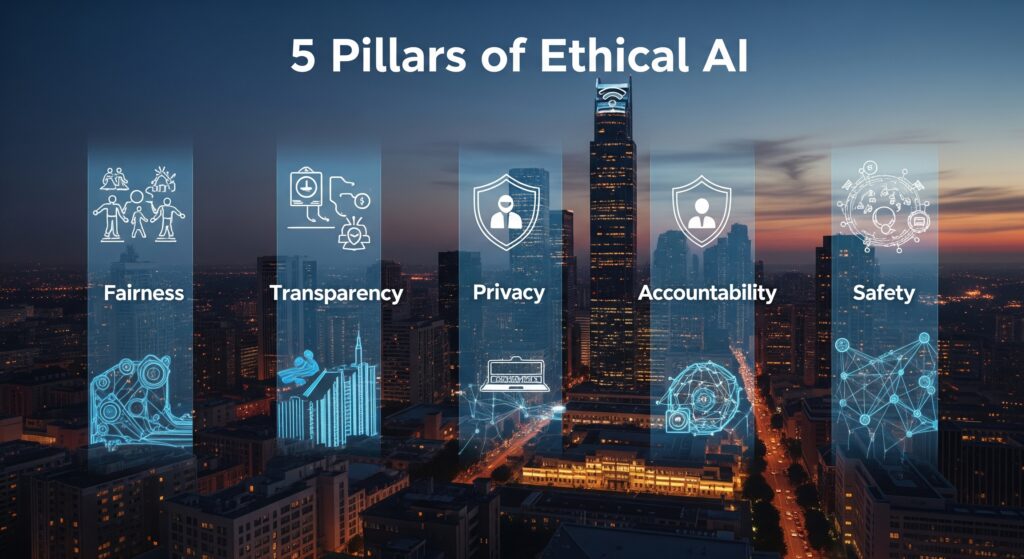
To navigate this complex landscape, experts have identified five foundational pillars of ethical AI: Fairness, Transparency, Privacy, Accountability, and Safety. These pillars act as guiding principles for organizations seeking to deploy AI responsibly while maximizing its societal and business value.
In this article, we will explore each pillar in depth, providing examples, challenges, and actionable strategies for integrating ethical AI practices across industries.
Fairness: Eliminating Bias and Promoting Equity
Understanding Fairness in AI
Fairness in AI ensures that algorithms do not discriminate against individuals or groups based on race, gender, age, socioeconomic status, or other protected characteristics. AI models are only as unbiased as the data they are trained on. Historical datasets often reflect societal inequities, which can be unintentionally embedded in AI systems.
Challenges to Fairness
Bias in AI can manifest subtly. For instance, recruitment AI trained on historical hiring data may favor certain genders or educational backgrounds. Similarly, predictive policing tools might disproportionately target marginalized communities if training data contains biased crime records. The consequences extend beyond individual harm; they can damage organizational reputation and invite regulatory scrutiny.
Strategies for Promoting Fairness
Organizations can adopt several measures to ensure fairness: using diverse datasets, implementing bias detection algorithms, and conducting regular algorithmic audits. In healthcare, AI diagnostic tools must be validated across multiple demographic groups to ensure equitable treatment outcomes.
Example: A fintech company deploying a credit scoring AI system audited its model across income brackets and ethnicities, retraining the system to reduce disparate impact.
Transparency: Making AI Understandable and Explainable
Why Transparency Matters
The 5 Pillars of Ethical AI, Transparency ensures that AI decisions can be understood by humans, fostering trust among users and regulators. As AI models become more complex, particularly deep learning and generative models, understanding their decision-making process becomes challenging.
Explainable AI (XAI)
Explainable AI (XAI) frameworks help demystify complex models. Techniques like feature importance analysis, surrogate models, and visualizations enable stakeholders to understand why an AI made a particular recommendation or decision. Transparency is critical in sectors such as finance and healthcare, where decisions have legal, ethical, and social implications.
Example: In healthcare, an AI system recommending treatments for cancer patients provides interpretable reasoning alongside its predictions, allowing oncologists to validate and trust the system.
Balancing Transparency with Intellectual Property
While transparency is essential, organizations must also protect proprietary algorithms. Techniques like model interpretability layers or explanation dashboards allow insights into AI behavior without exposing trade secrets.
Privacy: Protecting Personal Data
The Importance of Data Privacy
AI systems rely heavily on data. Collecting, storing, and processing sensitive information raises critical privacy concerns. Breaches or misuse of personal data can have severe consequences for individuals and organizations alike.
Regulatory Frameworks
Privacy regulations such as GDPR, CCPA, and emerging AI-specific laws enforce strict rules on data collection, storage, and processing. Compliance requires organizations to embed privacy principles into AI design, including data minimization, anonymization, and consent management.
Example: An AI-powered health monitoring app anonymizes user data before training predictive models, ensuring sensitive health information is protected while still enabling accurate predictions.
Privacy-Preserving AI Techniques
Techniques like differential privacy, federated learning, and homomorphic encryption allow AI systems to learn from data without compromising individual privacy. For instance, federated learning enables models to train across multiple devices without sharing raw data, making it ideal for healthcare or financial applications.
Accountability: Assigning Responsibility for AI Decisions
Defining Accountability
The 5 Pillars of Ethical AI, Accountability ensures that humans are responsible for AI decisions and their consequences. Ethical AI requires clear assignment of responsibility for design, deployment, monitoring, and corrective actions.
Organizational Accountability
Organizations must establish policies and governance structures that clarify who is responsible for AI outcomes. This includes data scientists, engineers, compliance officers, and executives. Accountability frameworks often involve documentation, decision logs, and audit trails to track AI actions.
Example: A social media platform implementing content moderation AI maintains an audit trail that links automated decisions to human reviewers for escalation, ensuring accountability and transparency in content removal.
Challenges
Accountability is particularly challenging for autonomous AI systems. In autonomous vehicles, assigning responsibility for accidents requires legal frameworks, insurance considerations, and real-time system monitoring. Clear accountability prevents ethical and legal ambiguity.
Safety: Ensuring AI Does No Harm
The Importance of Safety
Safety ensures that AI systems operate reliably, predictably, and without causing physical, financial, or societal harm. Safety encompasses both technical robustness and operational safeguards.
Technical Safety Measures
Developers must implement safeguards such as robustness testing, fail-safes, and anomaly detection. AI models should perform reliably under unexpected inputs or environmental changes. Safety-critical applications, such as autonomous driving or medical devices, demand rigorous testing and validation before deployment.
Example: Autonomous drones use AI to navigate complex environments. Safety mechanisms include collision detection, real-time environment mapping, and emergency shutdown protocols to prevent accidents.
Societal Safety
Beyond technical measures, safety extends to societal impact. AI systems should not exacerbate inequalities, manipulate opinions, or disrupt critical infrastructure. Ethical review boards, continuous monitoring, and stakeholder engagement are essential to ensure broader societal safety.
Integrating the Five Pillars in AI Lifecycle
Ethical AI is not just about individual principles; it is about integrating the five pillars across the AI lifecycle—from design and data collection to deployment and monitoring.
- Design and Planning: Incorporate fairness, privacy, and safety from the outset.
- Data Collection: Ensure representative datasets, anonymization, and consent management.
- Model Development: Apply bias mitigation, explainable AI techniques, and robustness testing.
- Deployment: Monitor performance, maintain accountability, and implement safeguards.
- Continuous Improvement: Reassess fairness, privacy, and safety as systems evolve and new risks emerge.
Example: A healthcare AI platform continuously audits diagnostic predictions, collects feedback from practitioners, anonymizes new patient data, and retrains models to improve both fairness and accuracy.
Case Studies of Ethical AI in Practice
Financial Sector
The 5 Pillars of Ethical AI, Banks deploying AI credit scoring systems audit their algorithms to ensure fair lending practices. They incorporate explainable AI dashboards, anonymize customer data, and establish accountability committees to review outcomes. These practices prevent discrimination and build customer trust.

Healthcare
AI-driven diagnostic tools use representative datasets to reduce bias across demographics. Transparent reporting of predictions and treatment recommendations ensures that physicians remain in control, maintaining accountability. Federated learning preserves patient privacy while enabling continuous model improvement.
Autonomous Vehicles
Self-driving car companies implement multi-layered safety protocols. AI systems are continuously tested in simulations, edge cases are documented, and accountability is shared among engineers, software managers, and vehicle operators. Transparency mechanisms allow regulators to audit decision-making processes.
Education
EdTech platforms leverage AI-driven adaptive learning while safeguarding student privacy. Bias audits ensure equitable learning opportunities, and transparent algorithms provide educators with actionable insights. Accountability is maintained through teacher oversight and continuous monitoring of model performance.
Challenges in Implementing Ethical AI
Despite the importance of ethical AI, practical implementation remains challenging:
- Data Bias: Historical and unrepresentative datasets can lead to unfair outcomes.
- Complexity of Explainability: Advanced models like deep neural networks are difficult to interpret.
- Conflicting Regulations: Different jurisdictions may impose contradictory requirements.
- Scalability: Maintaining fairness, transparency, and privacy across large-scale systems is resource-intensive.
- Evolving Risks: Emerging AI capabilities introduce new ethical challenges continuously.
Addressing these challenges requires cross-functional collaboration, regulatory compliance, and adoption of industry best practices.
Strategies for Embedding Ethical AI
- Ethical Design Frameworks: Integrate fairness, transparency, privacy, accountability, and safety from project inception.
- Bias Audits and Testing: Regularly evaluate models for discriminatory outcomes.
- Explainable AI Tools: Implement XAI techniques to make models interpretable.
- Privacy-Preserving Techniques: Use federated learning, anonymization, and encryption.
- Governance and Oversight: Assign accountability, maintain logs, and establish review boards.
- Continuous Monitoring and Improvement: Ethical AI is dynamic; systems must evolve responsibly.
Example: A global tech company uses an ethical AI toolkit that evaluates all models for bias, monitors privacy compliance, and enforces accountability protocols.
Future Outlook
The future of ethical AI lies in global cooperation, technological innovation, and regulatory alignment. Emerging AI technologies like generative AI, autonomous decision-making systems, and AI in critical infrastructure will magnify the importance of ethical governance.
Standardization of ethical guidelines across industries will help organizations implement best practices efficiently. Organizations that embed Fairness, Transparency, Privacy, Accountability, and Safety into AI will not only avoid legal and reputational risks but also gain competitive advantages by building trust with consumers and stakeholders.
Conclusion
The 5 Pillars of Ethical AI, Ethical AI is no longer optional—it is essential. The **five pillars—Fairness, Transparency, Privacy, Accountability, and Safety—**provide a comprehensive framework for responsible AI deployment. By embedding these principles across the AI lifecycle, organizations can ensure that their AI systems are trustworthy, reliable, and aligned with societal values.
Whether in finance, healthcare, education, or autonomous technologies, these pillars guide decision-making, promote equitable outcomes, and foster innovation that benefits everyone. Ethical AI is not just about compliance; it is about creating AI that enhances human potential safely, responsibly, and transparently.ction.
For more insights, visit the ClayDesk Blog: https://blog.claydesk.com