
Agentic AI vs. Traditional AI: Key Differences and Opportunities
Agentic AI vs. Traditional AI
Agentic AI vs. Traditional AI: Artificial intelligence has revolutionized the way humans interact with technology, businesses operate, and societies evolve. Yet, not all AI systems are the same. While traditional AI has been widely deployed for decades to perform narrow, task-specific functions, the emergence of agentic AI marks a paradigm shift, enabling autonomous decision-making, goal-driven behavior, and adaptive problem-solving across complex domains. Understanding the distinctions between these two approaches is crucial for organizations, policymakers, and individuals aiming to leverage AI responsibly and strategically.
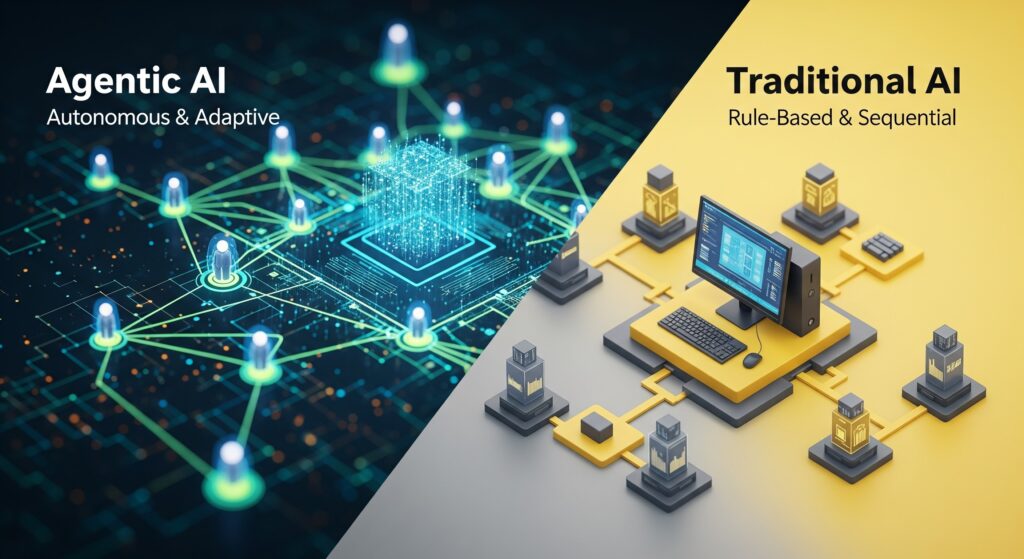
In the 1950s and 1960s, AI was primarily theoretical, consisting of symbolic reasoning systems that mimicked human logic. These systems relied heavily on explicitly programmed rules and could solve well-defined problems. As computational power increased, machine learning algorithms and neural networks emerged, enabling AI to recognize patterns, process language, and analyze large datasets. However, even these advanced systems remained narrow in scope, functioning within the confines of their training data.
The 21st century introduced agentic AI, capable of acting autonomously, pursuing objectives, and adapting strategies based on environmental feedback. Unlike traditional AI, agentic systems do not merely respond to input; they actively explore solutions, optimize outcomes, and interact dynamically with human and machine counterparts. This shift presents new opportunities across finance, healthcare, logistics, manufacturing, and governance while simultaneously raising ethical, legal, and societal challenges.
This comprehensive exploration delves into the evolution of AI, deep dives into traditional and agentic AI, highlights their key differences, examines industry opportunities, discusses ethical and regulatory concerns, and outlines a future trajectory for hybrid AI integration. By the end, readers will understand how to strategically position both AI forms to drive innovation, efficiency, and responsible automation in a rapidly evolving technological landscape.
Evolution of Artificial Intelligence
Artificial intelligence has progressed through distinct stages, each reflecting technological, theoretical, and computational advancements. Initially, symbolic AI dominated the landscape, emphasizing logic, rules, and explicit programming. These systems could perform tasks such as theorem proving, logical deduction, and simple problem-solving but lacked flexibility.
The advent of expert systems in the 1970s and 1980s represented a significant leap. Organizations deployed these systems for diagnostics, troubleshooting, and domain-specific decision support. For example, medical expert systems could provide preliminary diagnoses based on symptom input, demonstrating early AI utility in critical sectors. Yet, these systems were brittle, incapable of learning beyond their pre-programmed knowledge.
The 1990s and 2000s witnessed the rise of machine learning, wherein AI systems began learning patterns from data rather than relying solely on rules. Neural networks, decision trees, and support vector machines enabled predictive analytics, fraud detection, and recommendation engines. E-commerce platforms, banking institutions, and digital media companies leveraged these capabilities to improve efficiency, personalize experiences, and automate routine operations.
The introduction of deep learning and reinforcement learning further expanded AI’s capabilities. By processing massive datasets and identifying complex patterns, AI achieved breakthroughs in image recognition, natural language processing (NLP), and strategic game-playing. Landmark achievements, such as AlphaGo defeating human champions, illustrated the potential of AI systems capable of adaptive learning and long-term strategy optimization.
Despite these advancements, traditional AI remained narrow in application, excelling at well-defined tasks but lacking self-direction. Agentic AI emerged to address this limitation, emphasizing autonomy, goal-directed behavior, and adaptive reasoning. Unlike traditional AI, agentic systems can assess objectives, select strategies, and execute actions independently, often in complex and dynamic environments.
Defining Traditional AI
Agentic AI vs. Traditional AI: Traditional AI, often referred to as narrow or weak AI, encompasses systems designed for specific tasks with limited adaptability. These systems excel in areas where inputs, rules, and desired outputs are well-understood. Examples include predictive modeling in finance, diagnostic support in healthcare, and automated quality control in manufacturing.
Key characteristics of traditional AI include:
- Task specificity: Functions are limited to a pre-defined scope.
- Rule-dependency: Systems rely on training data or explicit programming.
- Predictable outcomes: Performance is measurable and replicable.
- Human supervision: Decisions often require oversight or approval.
Traditional AI has delivered significant value. For example, loan risk assessment models in banks analyze historical data to approve or reject applications, reducing default rates and improving efficiency. In healthcare, AI-assisted imaging identifies tumors and other anomalies with high accuracy, augmenting physician capabilities. In manufacturing, robotic process automation (RPA) ensures consistent quality control while minimizing human error.
However, these systems also exhibit limitations. Their inability to adapt to new or unforeseen scenarios constrains their application in volatile, uncertain, complex, and ambiguous (VUCA) environments. Traditional AI cannot autonomously set priorities, formulate strategies, or pursue evolving objectives. It functions reactively, lacking the self-directed intelligence that agentic AI introduces.
Understanding Agentic AI
Agentic AI represents a new frontier, characterized by systems capable of autonomous goal-setting, decision-making, and adaptive action. Unlike traditional AI, agentic AI does not require explicit human guidance for every operation. Instead, it leverages reinforcement learning, multi-agent coordination, and self-supervised learning to evaluate outcomes, optimize strategies, and interact dynamically with environments.
In practice, agentic AI can operate in highly complex domains. Consider autonomous supply chain management: agentic AI monitors inventory levels, predicts disruptions, negotiates with suppliers, reroutes shipments, and optimizes delivery schedules without direct human input. In healthcare, agentic systems may coordinate treatment plans, schedule interventions, and adapt recommendations based on real-time patient data.
Agentic AI’s defining capabilities include:
- Autonomy: Ability to act independently and pursue goals.
- Adaptability: Learning from outcomes and adjusting strategies in dynamic environments.
- Decision-making: Selecting actions based on trade-offs, probabilities, and potential consequences.
- Collaboration: Interacting with humans and other AI agents to achieve objectives.
By combining these capabilities, agentic AI systems offer efficiency, scalability, and operational intelligence beyond traditional AI. These systems can continuously improve their performance, anticipate challenges, and optimize outcomes in real time, providing a transformative advantage in industries with complex, rapidly changing requirements.
Key Differences Between Traditional and Agentic AI
Agentic AI vs. Traditional AI: Comparing traditional and agentic AI highlights fundamental contrasts in functionality, capability, and impact.
1. Autonomy vs. Supervision: Traditional AI requires human oversight, executing pre-defined tasks within set parameters. Agentic AI operates autonomously, capable of initiating actions and pursuing objectives without direct human intervention.
2. Adaptability: Traditional AI is narrow and static, while agentic AI learns and adjusts strategies dynamically. Reinforcement learning enables agentic AI to explore multiple approaches and optimize decisions over time.
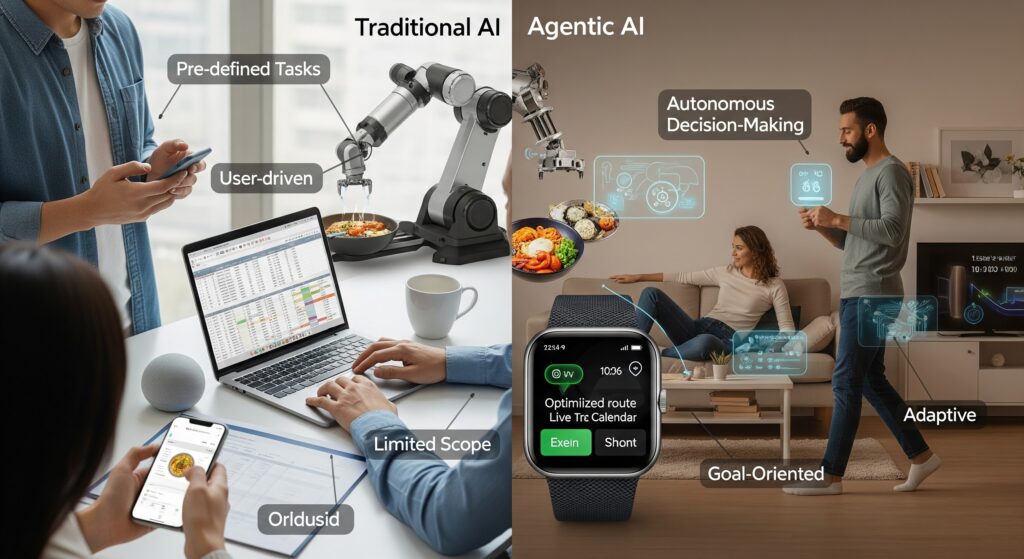
3. Decision-making: Traditional AI provides recommendations or executes pre-programmed rules. Agentic AI evaluates alternatives, weighs trade-offs, and selects actions that maximize long-term objectives.
4. Integration with Human Workflows: Traditional AI augments human tasks, whereas agentic AI can reshape workflows entirely, potentially automating complex processes that span multiple departments or domains.
5. Risk and Accountability: Traditional AI’s deterministic nature facilitates monitoring and regulation. Agentic AI introduces new risks, requiring robust governance, transparency, and ethical oversight. Autonomous decision-making increases potential for unintended consequences if not properly managed.
These differences demonstrate why organizations must strategically deploy both AI forms. Traditional AI remains invaluable for predictable, compliance-sensitive tasks, while agentic AI unlocks dynamic, strategic capabilities in complex and evolving environments.
Industry Applications and Opportunities
The rise of agentic AI introduces unprecedented opportunities across diverse sectors.
Finance: Autonomous AI agents continuously monitor global markets, optimize portfolios, detect fraud in real time, and automate trading strategies. Traditional AI models support predictive risk assessments, while agentic AI adapts investment strategies autonomously based on emerging market signals.
Healthcare: Agentic AI coordinates care across multiple providers, monitors patient recovery, and recommends interventions. Traditional AI assists with diagnostics and imaging analysis, while agentic systems proactively manage entire treatment plans.
Manufacturing: Smart factories integrate agentic AI for dynamic production planning, inventory allocation, and quality control. Traditional AI handles repetitive tasks, but agentic systems anticipate bottlenecks, optimize throughput, and adjust operations in real time.
Logistics and Supply Chain: Agentic AI autonomously reroutes shipments, manages fleet operations, and adapts to supply-demand fluctuations. Traditional AI assists with forecasting and route optimization but lacks the autonomy to execute strategic adjustments.
Retail: Autonomous customer engagement systems powered by agentic AI personalize experiences, optimize pricing, and adjust inventory based on behavioral trends. Traditional AI provides recommendation engines, inventory monitoring, and analytics support.
Government and Public Services: Agentic AI optimizes traffic management, energy distribution, and emergency response planning. Traditional AI supports data analysis, citizen services, and regulatory compliance but cannot make independent, context-sensitive operational decisions.
Ethical and Regulatory Considerations
Agentic AI vs. Traditional AI: With the rise of agentic AI, ethical responsibility becomes paramount. Autonomous decision-making raises questions about bias, fairness, transparency, and accountability.
Agentic AI systems must be designed to mitigate discriminatory outcomes. For instance, an autonomous hiring agent must ensure recruitment processes are free from bias, even if historical data reflects systemic inequalities. Similarly, financial AI agents must avoid market manipulation and systemic risk escalation.
Data privacy is another concern. Agentic AI relies on large-scale, often real-time data collection. Ensuring proper consent, secure storage, and responsible usage is critical to maintain public trust.
Explainability is essential. While traditional AI models are already difficult to interpret, agentic systems increase complexity, necessitating mechanisms to understand decisions and maintain transparency.
Governance frameworks are required to balance autonomy with human oversight. Ethical deployment demands monitoring, auditing, and proactive scenario planning to prevent unintended consequences.
Workforce and Societal Impacts
Agentic AI transforms how humans work, interact, and learn. Roles requiring repetitive or rule-based tasks may be automated entirely, while new positions emerge in AI governance, human-AI interaction design, and ethical oversight. Lifelong learning and reskilling become crucial for workforce resilience.
Societies must consider equity and inclusion. While agentic AI enhances efficiency and capability, it risks widening gaps between digitally advanced regions and underserved populations. Policy interventions and investment in digital literacy are necessary to ensure equitable benefits.
Human-machine collaboration becomes the norm. Professionals will focus on strategic thinking, creativity, and ethical oversight, while agentic AI handles operational and analytical execution. This partnership reshapes the concept of productivity and professional purpose.
Future Outlook
The future of AI involves hybrid ecosystems, combining traditional and agentic systems to balance reliability, autonomy, and adaptability. Reinforcement learning, multi-agent coordination, and adaptive algorithms will make agentic AI increasingly capable and trustworthy.
Potential developments include artificial general intelligence (AGI), self-optimizing autonomous systems, and AI-driven societal planning tools. Organizations embracing hybrid AI models will achieve faster innovation, better risk management, and enhanced decision-making.
Global competition for AI leadership will intensify, necessitating international collaboration to ensure responsible deployment, ethical standards, and equitable benefits. Sustainability-focused agentic AI applications will optimize energy, reduce waste, and support circular economies, aligning technological progress with environmental responsibility.
Conclusion
Agentic AI vs. Traditional AI: The evolution from traditional AI to agentic AI is a paradigm shift, transforming operational processes, strategic decision-making, and societal structures. Traditional AI remains essential for predictable, domain-specific tasks, while agentic AI unlocks autonomous problem-solving, adaptive planning, and dynamic optimization.
Organizations that integrate both forms strategically will gain competitive advantages, drive innovation, and ensure ethical AI deployment. Humans and machines will collaborate more closely than ever, blending creativity, judgment, and intelligence with autonomous efficiency.
The journey from narrow, task-specific AI to agentic, self-directed systems is reshaping the future of work, business, and society. Embracing this transformation responsibly is critical to unlocking the full potential of AI while mitigating risk, ensuring fairness, and promoting sustainable growth.
For more insights, visit the ClayDesk Blog: https://blog.claydesk.com