
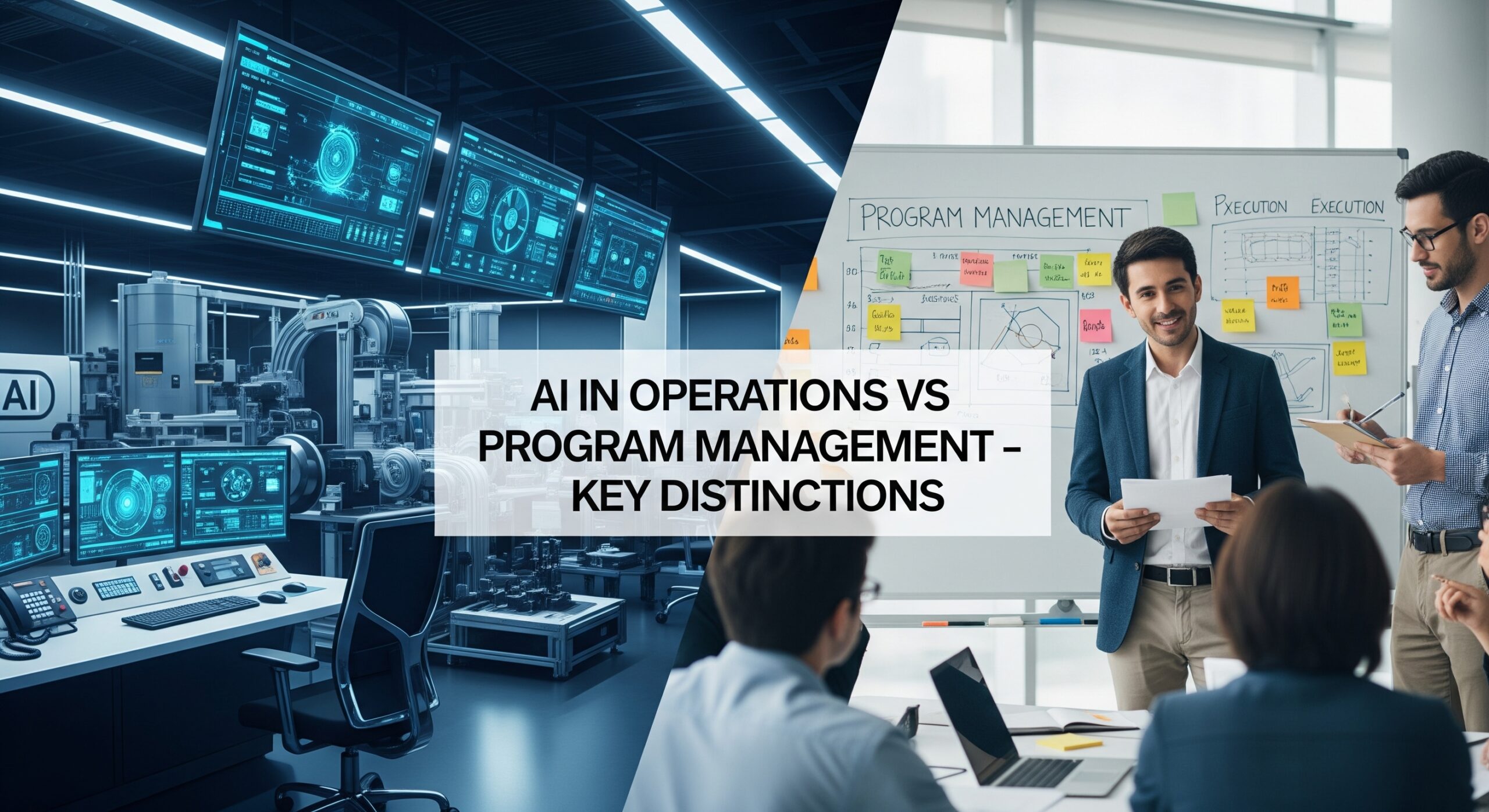
AI in Operations vs Program Management – Key Distinctions
Introduction: The Transformative Power of AI
AI in Operations vs Program Management – Key Distinctions. Artificial Intelligence (AI) is no longer a futuristic concept; it is a present-day force, fundamentally reshaping how businesses operate. It drives change across every department, from finance to human resources, with its most significant and distinctive effects in Operations Management and Program Management While both fields leverage AI to enhance efficiency and decision-making, their application, goals, and methodologies are fundamentally different. This document delves into each field’s distinctions, explains their foundational principles, and illustrates how AI adapts to their unique requirements.
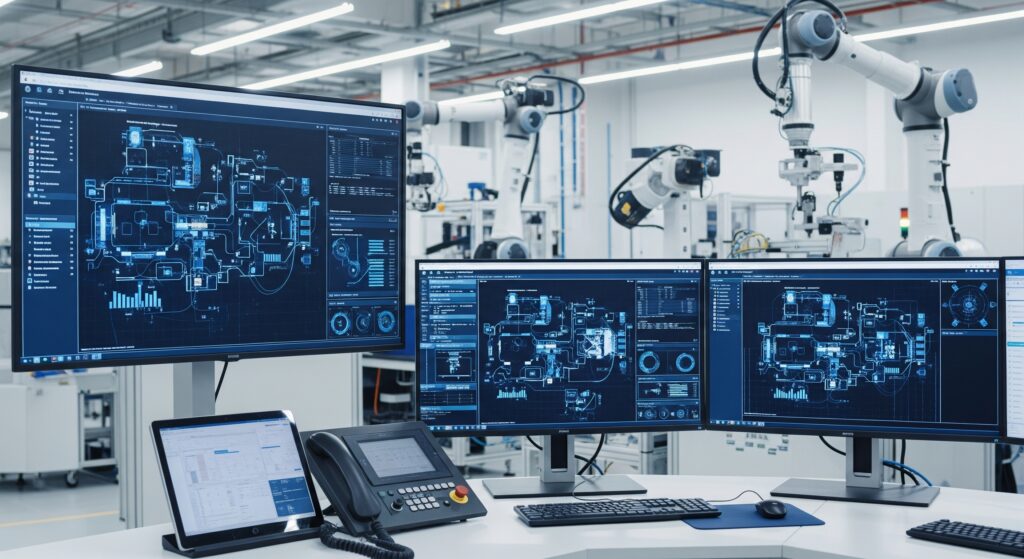
Part 1: The Role of AI in Operations Management
Operations Management is the discipline concerned with managing the process of creating goods and services. Its core objective is to maximize efficiency, minimize costs, and ensure the seamless flow of business activities. It is a world of repetitive, high-volume tasks where even minor optimizations can lead to significant cost savings and performance gains. AI in operations is therefore a tool for automation, optimization, and predictive analytics at scale.
1.1. Predictive Analytics and Maintenance
AI in Operations vs Program Management – Key Distinctions. One of the most powerful applications of AI in operations is predictive maintenance. In a manufacturing plant, a logistics network, or a data center, equipment failure is a massive source of unplanned downtime and cost. Historically, maintenance has been either reactive (fixing something after it breaks) or preventive (fixing something on a fixed schedule, whether it needs it or not). Both approaches are inefficient.
IoT devices
AI changes this paradigm. Using sensors (IoT devices) on machinery, AI algorithms can analyze a constant stream of data—including temperature, vibration, sound, and pressure—to predict when a component is likely to fail. The model identifies subtle patterns that a human eye would miss, such as a slight increase in bearing temperature or a change in the frequency of a motor’s hum, long before the component gives out.
1.2. Supply Chain and Logistics Optimization
The supply chain is a complex web of interconnected processes, from sourcing raw materials to delivering finished products. It is a primary domain for operations management, and AI is revolutionizing it. AI models can analyze historical demand data, current market trends, and even external factors like weather forecasts or social media sentiment to create highly accurate demand forecasting models. This allows businesses to optimize their inventory levels, reducing holding costs and the risk of stockouts. The insights provided by AI help in making smarter decisions about how much product to manufacture, where to store it, and when to ship it.
forecasting AI
Beyond forecasting, AI is a key player in logistics optimization. It can solve complex routing problems that are beyond the capacity of traditional software. For a fleet of delivery trucks, an AI algorithm can compute the most efficient routes, taking into account real-time traffic data, fuel consumption, and delivery windows. This doesn’t just save time; it reduces fuel costs and carbon emissions, contributing to a more sustainable operation.
Companies using AI
Companies are also using AI to manage warehouses, with robots autonomously moving products and AI systems directing human workers to the most efficient pick paths. The result is a supply chain that is not only faster and cheaper but also more resilient and responsive to real-time changes.
1.3. Quality Control and Process Automation
AI in Operations vs Program Management – Key Distinctions. Quality control is another area where AI has made a significant impact in operations. In manufacturing, AI-powered computer vision systems can inspect products on a production line with speed and accuracy that no human can match.
These systems can detect minute defects, such as a microscopic scratch on a smartphone screen or a misshapen component, ensuring that only perfect products make it to the customer.
The AI model learns what a “perfect” product looks like from thousands of examples and can instantly flag any deviations. This not only improves product quality but also reduces waste and the costs associated with manual inspections.
AI is the Engine
Furthermore, AI is the engine behind robotic process automation (RPA), which automates repetitive, rule-based digital tasks. In operations, this could involve AI bots processing invoices, updating inventory records, or handling customer service inquiries.
This frees up human employees from mundane tasks, allowing them to focus on more complex, strategic work. The goal is to create a more efficient and error-free operational workflow, where routine tasks are handled by AI and human ingenuity is applied where it adds the most value.
1.4. Resource and Energy Optimization
In operations, every watt of energy and every dollar of resource counts. AI is being used to analyze real-time energy consumption data in factories, buildings, and data centers. It can identify patterns and anomalies in energy usage and recommend adjustments to lighting, heating, and cooling systems to reduce waste. For example, an AI system might detect that a machine is using excessive power during off-peak hours and suggest an optimized schedule. In a complex network of power grids, AI can balance supply and demand more efficiently, preventing power outages and reducing costs. This type of optimization, driven by vast amounts of data, is a core application of AI in operations.
Part 2: The Role of AI in Program Management
While operations management is about the continuous, repetitive process of making a product or service, Program Management is about achieving a specific, strategic business objective through a coordinated set of projects. A program is temporary; once the goal is achieved, the program concludes. The focus here is not on efficiency of a single task but on the successful delivery of a complex, multifaceted initiative. AI in program management is a tool for strategic decision-making, risk mitigation, and resource allocation across multiple projects.
2.1. Strategic Alignment and Predictive Insights
AI in Operations vs Program Management – Key Distinctions. A key challenge in program management is ensuring that all the projects within the program are aligned with the overall strategic objective. AI can help a program manager analyze a massive amount of project data—schedules, budgets, resource reports, and stakeholder feedback—to provide a high-level view of the program’s health. It can identify which projects are on track, which are falling behind, and which might be at risk of derailing the entire program.
AI-driven predictive analytics
By applying AI-driven predictive analytics, the program manager can forecast potential delays or cost overruns months in advance, giving them ample time to intervene. The AI can also identify dependencies between projects that might not be obvious to a human, such as a seemingly minor delay in one project having a cascading effect on three others. This allows the program manager to focus on the most critical risks and opportunities.
2.2. Intelligent Risk Management
Risk is inherent in any large program. Unlike in operations, where risk is often related to a physical failure or a supply chain disruption, program risks are often more abstract and interconnected. They can include resource conflicts, changes in market conditions, or unforeseen technological challenges. AI can act as an intelligent risk management system, continuously scanning project data, market news, and internal reports to identify potential threats.
2.3. Resource Allocation and Optimization
In program management, resource allocation is a continuous and complex puzzle. A program manager must allocate people, budget, and time across multiple, often competing, projects. A single key expert might be needed on two different projects at the same time, or a budget cut in one area might jeopardize a critical milestone in another. AI provides a powerful solution to this problem. An AI-powered system can model various scenarios and recommend the most optimal allocation of resources to meet the program’s objectives.
2.4. Project Portfolio and Dependency Management
AI in Operations vs Program Management – Key Distinctions. A program is a collection of interrelated projects. Managing these relationships is a monumental task. The failure of one project can jeopardize the entire program. AI systems can map out and monitor these dependencies in real-time. If a key deliverable from Project A is delayed, the AI can immediately notify the program manager of the ripple effect on Project B and Project C, which were dependent on that deliverable.
It can then recommend a revised timeline or an alternative path to mitigate the impact. This proactive approach to dependency management is a significant departure from traditional methods, which often rely on manual reporting and static charts that are quickly outdated. The AI can also provide insights into the overall project portfolio, helping a program manager decide whether to continue, modify, or even cancel a project that is no longer aligned with the program’s strategic goals.
Part 3: The Key Distinctions and Comparative Analysis
The application of AI in these two fields is best understood through a direct comparison. While they both use similar technologies, their purpose and application are diametrically opposed.
3.1. Purpose and Goal
The fundamental purpose of AI in operations management is to achieve operational excellence. The goal is efficiency, cost reduction, and process optimization. It is about doing the same thing, but doing it faster, cheaper, and with higher quality.
Impact of AI
The impact of AI is measured in tangible metrics: reduced downtime, lower energy consumption, faster delivery times, and fewer defects. The focus is on the continuous, day-to-day improvement of a repetitive process.
In contrast, the purpose of AI in program management is strategic success. The goal is to ensure the program achieves its unique, high-level business objective. The impact of AI is measured by the program’s on-time and on-budget completion, its ability to mitigate risk, and its successful delivery of the intended business value. The focus is on the one-time, non-repetitive task of leading a strategic initiative.
3.2. Data Type and Focus
Structured data from sensors, production systems, and logs powers AI in operations, enabling models to learn from repetitive, high-volume data for predictive analytics and automation The data is often real-time and continuous, such as a constant stream of temperature readings from a machine. The models are trained to identify patterns and anomalies in this structured, predictable data.
Unstructured data
AI in Operations vs Program Management – Key Distinctions. AI in program management uses a more diverse mix of data. While it also uses structured data like budgets and schedules, a significant portion of its value comes from analyzing unstructured data from emails, team chats, project documents, and meeting notes. The AI is not looking for a predictable pattern of machine failure; it is looking for subtle signals of risk or misalignment in the complex, human-driven activities of a program.
3.3. Scope and Scale
The scope of AI in operations can be immense, spanning entire factories, supply chains, or global logistics networks.Built to scale, the models process enormous volumes of real-time data from countless sources, affecting both micro-level machines and the macro-level manufacturing line, all within the scope of ongoing operations.
AI in program management
The program sets the boundaries for AI in program management The AI is not a continuous, monitoring system; it is a decision-support tool for the program manager, providing a holistic view of a temporary initiative. We assess scale based on the complexity of interactions and dependencies between projects, teams, and stakeholders, rather than the volume of physical output.
3.4. Decision-Making and Automation
In operations, AI often leads to automation. The AI system might autonomously shut down a machine, reroute a package, or adjust a temperature setting without human intervention. These decisions are often deterministic, allowing machines to execute them. The goal is to remove the human from the loop for routine tasks.
In program management, AI is primarily a decision-support tool. It doesn’t autonomously cancel a project or reassign a team. Instead, it provides the program manager with the insights, warnings, and scenario analyses they need to make a well-informed decision. The final call and the strategic direction always remain in human hands. The AI‘s role is to augment the program manager’s judgment, not replace it.
Part 4: The Synergistic Future and Conclusion
AI in Operations vs Program Management – Key Distinctions. The distinction between AI in operations and program management is clear, but they are not mutually exclusive. In fact, modern enterprises achieve the greatest benefit by integrating these two disciplines. The data from an AI-optimized operations workflow can provide invaluable input to a program manager. For instance, a program to launch a new product would benefit from real-time data from the manufacturing and supply chain operations, allowing the program manager to make more accurate predictions and mitigate risks more effectively. This synergy is the future of AI in business.
The key takeaway is that AI is not a monolithic solution. Its power lies in its adaptability. For the world of operations, AI is a continuous engine of efficiency, focused on automation and optimization of repetitive tasks. For the world of program management, AI is a strategic partner, focused on providing predictive insights and decision support for complex, one-time initiatives. Understanding this fundamental distinction is the first step toward harnessing the full, transformative power of AI in an enterprise. It’s about using the right tool for the right job, and in the case of AI, that means recognizing its unique role in driving both day-to-day excellence and long-term strategic success.
For more insights, visit the ClayDesk Blog: https://blog.claydesk.com