
MCP vs API: The AI Game Changer
MCP vs API: The AI Game Changer (Why Your API Isn’t Enough & How to Build It Right!)
So, if you’re like most developers today, you’re probably using tools like ChatGPT to help you write code or solve problems.
And yeah, that’s cool—but let me tell you something important: There’s a big difference between just using ChatGPT and really unlocking its full power. What I’m about to show you today takes things to a whole new level. Therefore, we’re talking about something called the Model Context Protocol, or MCP.
Think of it like putting AI on supercharged mode. This isn’t just about asking better questions or writing longer prompts—it’s about completely changing how AI like ChatGPT connects with the world around it.
Let’s break it down.
For a long time, AI models—like the early versions of GPT—were kind of limited. They were smart, sure, but only in a fixed way. it could generate good text based on what you typed in, but that was pretty much it. They couldn’t learn new things on the fly, they couldn’t get real-time updates, and they definitely couldn’t reach out and interact with other systems or tools in the real world.
Basically, they were like a smart textbook—useful, but stuck in time.
But now? With MCP, that’s changing in a big way.
“Let’s quickly trace the journey of LLMs to understand why MCP is so revolutionary.”
Early LLMs (GPT-2, early GPT-3): Initially, LLMs were “text prediction engines”. They generated human-like text responses from a prompt but were inherently static. Their knowledge was “bound by their training data” and “limited to the content that could be embedded in a fixed length prompt”. They couldn’t update their knowledge or interact with external environments.
In-Context Learning:
To overcome some limitations, developers started “stuffing the model’s context window with task-specific information, examples, and instructions”. This helped with zero-shot or few-shot tasks, “essentially tricking it into thinking the input prompt was part of its training distribution”. However, this lacked scalability and modularity. Models “could not autonomously seek additional context” or “execute tasks or retrieve external knowledge dynamically”.
Retrieval Augmented Generation (RAG):
Essentially, this was a big step forward. RAG combined LLMs with information retrieval systems, allowing the model to “retrieve relevant documents from external knowledge bases,” often using “semantic search with vector databases,” and incorporate that information into the generation process. RAG “helped bridge the knowledge gap between model pre-training and current information” and became a “staple for building AI applications” needing up-to-date or domain-specific info.
The RAG Limitation:
But here’s the kicker: RAG was “fundamentally read-only”. The model “could observe data but could not interact with it”. It couldn’t “perform transactions, query APIs, or affect stateful systems in the world”.
Tool-Augmented Agents:
This led to the “next leap” – tool-augmented agents. These allowed LLMs to “go beyond passive retrieval and into action execution,” invoking “external APIs, databases, or other software tools dynamically during a conversation”. The problem? This capability “required new infrastructure and designed patterns to ensure consistency, security, and developer ergonomics”.
Before MCP, integrating LLMs with external systems was a “complex endeavor,” leading to a “proliferation of bespoke solutions that were difficult to maintain and scale”. This was the “M by N integration problem”.“And that, my friends, is where the Model Context Protocol, or MCP, comes in.”
What it is MCP
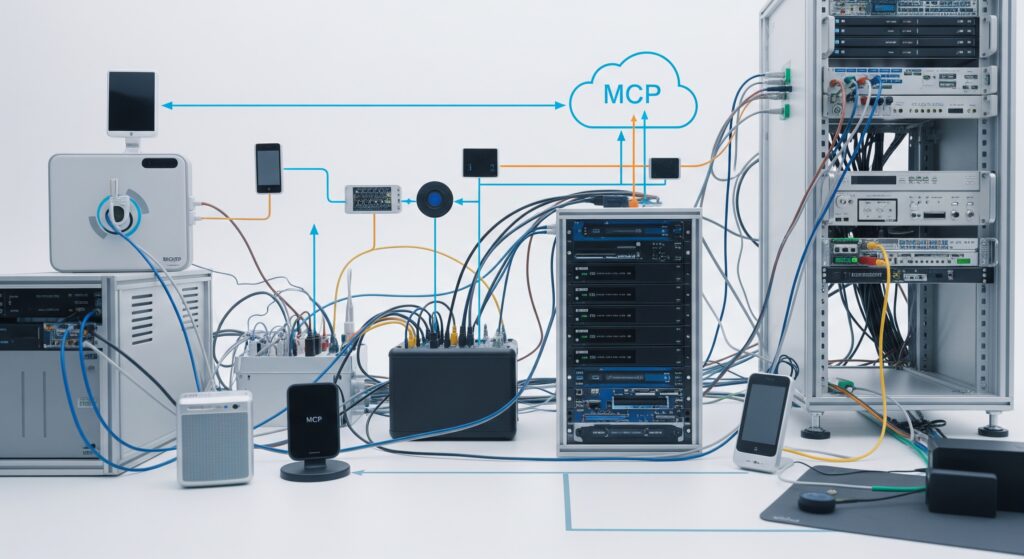
Now, MCP is a “groundbreaking architecture developed by Anthropic”, the company behind Claude. It’s an “open protocol that standardizes how applications provide context to LLMs”. Think of MCP “like a USBC port for AI applications”. Just as USBC standardizes connecting devices to peripherals, “MCP provides a standardized way to connect AI models to different data sources and tools”.
How it works (High Level)
It allows LLMs to “interact with external systems like tools, data, and APIs in a structured and declarative manner”. MCP “abstracts the interface between the LLM and its tool use context,” allowing models to “request capabilities or data they don’t have internally,” while enabling tool providers to “expose their capabilities safely and scalably”.
Core Benefit:
Whereas, this fundamentally “turns the LLM into a reasoning engine and orchestrator”! It becomes “capable of performing multi-step operations like database queries, code execution, or even user-specific recommendations”. LLMs “no longer rely solely on pre-training or retrieval but can dynamically extend their abilities through secure pluggable interfaces”. MCP solves critical pain points: “knowledge staleness, limited context, and the inability to act”.
Massive Adoption:
Therefore, this isn’t some niche tech. MCP is getting “tremendous adoption”. David Gomes from Neon, a serverless Postgres provider, highlighted its prevalence: “Windows Copilot will become an MCP client soon,” “Google I/O announced that Gemini will support MCP as well,” “OpenAI already supports MCP,” and “Claude of course has supported MCP from the beginning”. The message is clear: “if you’re building an app or a service and you want LLMs to use your app, you need an MCP server”.
So, how does this magic happen? MCP defines a three-part architecture:
1.MCP Host:
Above all, this is the “container environment running the LLM or integrating it into a larger software system”. Think of it as the “orchestrator“. It manages clients, routes requests between the LLM and the outside world, and enforces security.
2.MCP Client:
Basically, this acts as a “translation layer”. It enables the LLM (via the host) to “interact with an external system in a normalized and schema-driven way”. It translates LLM intents (often JSON requests) into structured calls to the underlying MCP server. Clients maintain “one-to-one connections with MCP servers”.
3.MCP Server: This is the “external tool or service the model is trying to access”. The server “implements the MCP spec” and “exposes a set of capabilities using structured JSON schemas”.
These capabilities include:
Resources: “Retrievable objects like files or documents”.
Tools: “Perform actions or make changes”. These are the “most important”, allowing the LLM to perform actions like “buy an item on your website” or “create a postgres database”.
Prompts:
“Reusable LLM called templates”.
“Communication between the client and server happens via two main methods:”
Standard IO:
Essentially, used for “local tools or CLI style utilities”. It’s “very fast,” has “no network latency,” and is “simple to implement,” great for local dev tools or sandboxed plugins.
HTTP and Server-Sent Events (SSE):
Hence, it is used for “remote or network tools,” often in cloud or containerized environments. The client sends HTTP POST requests, and the server “streams responses back using SSE”. SSE is crucial because it “allows incremental or streaming results” (like log tails or async job status) and “enables long-lived interactions without blocking”.
“MCP also has important protocol design principles:”
Declarative and Self-Describing:
Hence, MCP servers are introspectable. They “declare what resources, tools, and prompts they expose,” enabling “dynamic discovery and adaptive reasoning by the model”. This is similar to OpenAPI or GraphQL’s introspection.
Extensible and Modular:
“Anyone can write a conforming MCP server for any tool or API”. An LLM “can interact with dozens of such tools simultaneously,” and “new tools can be hot plugged without retraining or reconfiguring the model itself”.
“In practice, the LLM uses MCP to discover tools dynamically via introspection, then requests operations in structured formats, and finally processes the response from tools as part of their reasoning loop.”
“Now, this is where it gets critical, and where “99% of developers don’t get MCP” right. There’s a common trap: just auto generating an MCP server from your existing OpenAPI spec. While it sounds easy, and services exist to do it, it isn’t quite right.” Here’s why you should NOT just expose your raw API as an MCP server:
Problem 1: Extensive APIs & Too Many Tools Lead to Poor LLM Performance
Most APIs, like Neon’s with 75-100 endpoints, are very extensive.
LLMs are “really, really terrible at choosing from a long list of tools”. If you give them “too much choice, they won’t really know what to do,” and “they’ll get very confused”.
Basically, even with “a million tokens” context windows, LLMs perform “much better with a reduced context size”. Auto Generating means you’ll get all your API endpoints as tools, and “LLMs will not perform well against your service”. You “have to make a choice here”.
Problem 2: API Descriptions Are Written for Humans, Not LLMs
“API endpoints are written for humans who can Google things and can reason about things”.
“LLMs need you to be a lot more direct with them”. They also “need examples much more than humans do”.
◦Neon, for example, writes their tool descriptions in XML, in a “very organized manner,” to “give the LLM as much context as possible about each individual tool and when to use it”. This is different from typical API documentation.
You need to “think about how to write the descriptions of all of your MCP tools for LLMs”.
Problem 3: APIs are for Low-Level Resource Management; LLMs Need Tasks/Actions
Most APIs are designed for developers to “use those APIs for automation” and “low-level resource management”.
“This is not what LLMs need from an API. LLMs need tasks. They need actions and tools”. They are “much more human-like” and care “about achieving a specific goal,” not “low-level resource creation”.
MCP was created because “OpenAPI schemas out there today are not really prepared for this kind of design”.
Problem 4: Missing Out on LLM-Specific Potential
If you just expose your API, you’re “missing out on the potential to create many more interesting things”.
Consider Neon’s database migration example. A naive approach would be a single “Run SQL” tool. But Neon exposed purpose-built MCP tools: “Prepare Database Migration” and “Complete Database Migration”.
The “Prepare” tool stages the migration on a temporary branch and then tells the LLM to “go and test the migration before you commit it”. The LLM can then call “Complete Database Migration” when ready.
This “complex, multistep workflow” makes sense for LLMs because they aren’t great at SQL, and it helps them test. This kind of workflow wouldn’t typically be exposed in a traditional API but is perfect for an MCP server.
“So, what’s the right way to build your company’s MCP server if you haven’t yet? Definitely don’t autogenerate it completely.”
The Hybrid Solution: You can start by autogenerating from your OpenAPI schema, but then “cut down as many tools as possible”. Remember, “the worst thing you can give an LLM is too much choice”. Remove non-essential tools.
Rewrite Descriptions:
Hence, “Evaluate the descriptions for all of your tools” and rewrite them specifically for LLMs, making them direct and providing examples.
Design LLM-Centric Tools:
Then,”Think about interesting tools that you might want to expose to an LLM but you maybe don’t want to have in your API”. Focus on tasks and multi-step workflows.
Implement Evals (AI Tests):
Now, You “should have evals and you should have tests to ensure that LLMs can use your MCP server correctly”. Since LLMs are “nondeterministic,” you need to run these tests “100, 1,000, 10,000 times” to ensure your tool descriptions are effective and LLMs are calling the right tool for the right job.
“The power of MCP is already being demonstrated in amazing ways:”
Deep Agent from Abacus AI:
So, This system, part of the Chat LLM ecosystem, “integrates with virtually any MCP server”. Deep Agent can “connect to your existing tools and services, understand complex objectives and autonomously execute intricate multi-step workflows”.
Now, It can transform “Figma mockups effortlessly into fully coded responsive websites”.
It can analyze GitHub pull requests, pinpointing code changes, API modifications, and architectural shifts.
It can even “intelligently chat with Google Maps to plan optimized multi-stop routes” based on dynamic needs, like finding top-rated coffee shops and creating an itinerary.
Thus, mastering MCP is rapidly becoming an essential skill for developers and professionals in today’s technological landscape. Understanding and effectively implementing this protocol will equip you to build the next generation of intelligent, action-oriented AI applications.
You can learn more about real-world skills and grow your career with comprehensive courses that offer unlimited access to over 1000 courses, including AWS certifications, DevOps, and web development.
For more insights, visit the ClayDesk Blog: https://blog.claydesk.com