

AI-Driven Automation: Benefits, Challenges, and Real-World Applications
Introduction
AI-Driven Automation, The global economy is undergoing a rapid transformation fueled by AI-driven automation. Across industries as varied as healthcare, manufacturing, retail, finance, agriculture, and logistics, automation powered by artificial intelligence technologies is shifting the way organizations operate, make decisions, and deliver value. In 2025, what was once viewed as futuristic speculation has now become a core element of business strategy. Enterprises that leverage automation with AI not only boost efficiency but also gain competitive advantages that were unimaginable a decade ago.

This shift is not merely about machines replacing humans in repetitive tasks. It is about creating intelligent systems that augment human abilities, drive innovation, and build scalable operations that respond to complex challenges in real time. However, with opportunity comes responsibility. While AI automation benefits include cost reduction, personalization, and accelerated innovation, challenges such as workforce displacement, ethical dilemmas, and cybersecurity risks remain significant.
To truly understand the strategic role of AI-driven automation, it is important to explore its benefits, challenges, and real-world applications in detail. Through concrete examples and deep analysis, this article provides a comprehensive overview of how automation is reshaping industries and what the future holds.
The Transformative Benefits of AI-Driven Automation
Enhancing Efficiency and Productivity
One of the most profound advantages of AI-powered automation lies in its ability to dramatically enhance productivity. Unlike traditional mechanized systems, AI algorithms continuously learn and improve, making processes faster, more accurate, and adaptive.
AI-Driven Automation, Consider the case of smart factories in automotive manufacturing. Companies like BMW and Tesla have embraced autonomous robotic arms that not only assemble vehicles but also conduct real-time quality inspections. These systems identify defects with near-perfect accuracy, something even the most experienced human inspectors could miss under pressure. The outcome is higher productivity with fewer defective units reaching customers.
In office settings, AI-driven workflow automation software processes invoices, payroll, and compliance reports. What once required hours of manual work now happens in minutes. At scale, this translates into thousands of hours saved, allowing human workers to redirect energy toward strategic tasks.
In logistics, AI route optimization systems process live traffic, weather conditions, and fuel efficiency data to reroute deliveries. Companies like UPS report saving millions of gallons of fuel annually thanks to AI-powered delivery optimization systems. Such examples underscore how AI automation directly improves both efficiency and sustainability.
Cost Reduction and Resource Optimization
The financial benefits of automation cannot be overstated. By reducing the reliance on manual intervention, businesses cut costs dramatically. But beyond labor savings, AI automation tools optimize resource allocation across multiple levels of operation.
Take energy management in commercial real estate as an example. AI energy optimization platforms analyze occupancy data and adjust lighting, heating, and air conditioning accordingly. This has led to energy savings of up to 30% in large-scale office buildings, translating to millions of dollars annually.
In retail, AI-driven inventory management systems predict demand fluctuations with remarkable accuracy. Walmart, for instance, employs machine learning algorithms that assess seasonal trends, customer preferences, and supply chain conditions. This reduces waste by avoiding overstocking while ensuring shelves remain stocked with high-demand products.
Healthcare institutions also rely on AI automation to optimize the allocation of medical equipment. During peak times, hospitals have used predictive analytics tools to anticipate which wards will need ventilators or ICU beds, ensuring that resources are never wasted or misallocated. These improvements not only save money but also enhance service quality in critical sectors.
Enabling Personalization at Scale
Perhaps no other benefit has reshaped customer experience more than AI-driven personalization. Businesses now use natural language processing (NLP) and predictive analytics to deliver tailored interactions to millions of customers simultaneously.
Streaming platforms like Netflix and Spotify use AI recommendation engines to suggest shows or songs that match user preferences. E-commerce giants such as Amazon rely on AI-powered product recommendation systems that analyze browsing history, purchase behavior, and even real-time interactions to propose products that align with customer needs. This level of personalization drives sales and strengthens brand loyalty.
AI-Driven Automation, In education, AI adaptive learning systems create individualized lesson paths for students. Platforms like Coursera and Khan Academy employ AI-driven analytics to monitor learner progress and adjust difficulty levels, ensuring students neither feel overwhelmed nor bored. Similarly, in healthcare, precision medicine powered by AI automation recommends treatments tailored to genetic markers and medical history, improving patient outcomes significantly.
The scalability of such personalization would be impossible through human effort alone. By combining vast datasets with AI automation, organizations create experiences that feel personal while serving millions.
Supporting Innovation and Growth
Automation is not merely about efficiency; it is also about unlocking creativity. With repetitive tasks delegated to machines, human talent can focus on higher-order thinking, strategy, and experimentation.
In product design, generative AI systems are integrated into automation workflows to simulate prototypes. For example, Adidas uses AI-driven automation in design to test shoe performance virtually, saving months of manual prototyping. In pharmaceuticals, AI-powered drug discovery systems analyze millions of molecular combinations in weeks, a process that once took years. This accelerates the pipeline for new medicines and vaccines.
Startups also benefit from automation through AI development platforms. Tools that automate coding tasks or perform real-time testing allow entrepreneurs to launch products faster and cheaper than ever before. Established corporations leverage AI predictive analytics to identify emerging markets and consumer trends before competitors.
Innovation fueled by automation has ripple effects. As businesses grow more efficient, they have more capital and time to reinvest in research and development. This creates a virtuous cycle where AI-driven automation continuously pushes industries forward.
Challenges of AI-Driven Automation
Workforce Displacement and Job Transformation
The most pressing concern surrounding automation with AI is its impact on employment. By 2025, millions of jobs across logistics, manufacturing, and customer support have been reshaped or eliminated. For example, AI-powered chatbots now handle queries that once required large call center teams. Autonomous trucks are disrupting freight transport, potentially displacing long-haul drivers.
Yet the conversation is more complex than simple job loss. Many new roles have emerged around AI system maintenance, data science, cybersecurity, and human-AI collaboration management. The challenge lies in reskilling workers fast enough to adapt. For instance, Amazon’s $700 million upskilling program trains warehouse workers in coding and robotics. However, not all companies have the resources to invest at this scale.
AI-Driven Automation, If reskilling initiatives fail, entire communities dependent on traditional industries risk economic collapse. Governments must collaborate with private enterprises to build sustainable pathways into new forms of work, ensuring that automation benefits are shared rather than concentrated.
Ethical and Fairness Concerns
Deploying AI-driven automation systems also introduces ethical dilemmas. Algorithms trained on biased datasets replicate and amplify existing inequalities. Consider recruitment automation tools that inadvertently prioritize candidates of certain genders or ethnic backgrounds due to historical hiring patterns embedded in the training data.
In healthcare, AI diagnostic systems sometimes show lower accuracy for underrepresented populations. This raises fairness concerns when decisions directly impact patient health. In finance, automated credit scoring algorithms may unfairly penalize applicants based on socioeconomic factors.
Transparency remains a major hurdle. Black box AI models often provide results without clear reasoning, leaving businesses unable to justify their decisions to regulators or consumers. To address this, explainable AI (XAI) frameworks are being developed, but striking the right balance between transparency and accuracy continues to challenge researchers.
Security Risks and Cyber Threats
Automation at scale creates new vulnerabilities. Adversarial AI attacks manipulate machine learning models by altering input data in ways invisible to humans. For example, subtle changes to road signs can trick autonomous vehicles into misinterpreting them, leading to catastrophic outcomes.
Cybercriminals are also leveraging AI automation tools to create adaptive malware that evolves to bypass security systems. Traditional firewalls and signature-based antivirus programs struggle against these dynamic threats. Companies must now invest in AI-driven cybersecurity platforms that detect anomalies in real time and respond proactively.
The rise of deepfake technology poses another challenge. Automated systems can generate realistic but false audio or video evidence, raising risks in politics, business, and personal security. Addressing these threats requires global cooperation, as cyber risks transcend borders.
Economic and Social Inequality
The adoption of AI-powered automation risks widening inequality both within and between countries. Large corporations with resources to deploy advanced automation enjoy exponential productivity gains, while small businesses lag behind.
On a global scale, developed nations dominate the AI innovation ecosystem, while developing nations struggle with limited infrastructure. Without international support, this could entrench existing global divides. Policies that democratize access to AI automation platforms, cloud infrastructure, and open-source tools will be essential to ensuring equitable growth.
Real-World Applications of AI-Driven Automation
Manufacturing and Industry 4.0
In smart factories, AI-driven automation systems oversee production lines, conduct predictive maintenance, and optimize supply chains. Siemens, for instance, uses digital twin technology to simulate factory operations, allowing engineers to test changes virtually before implementation. This reduces downtime and enhances customization.
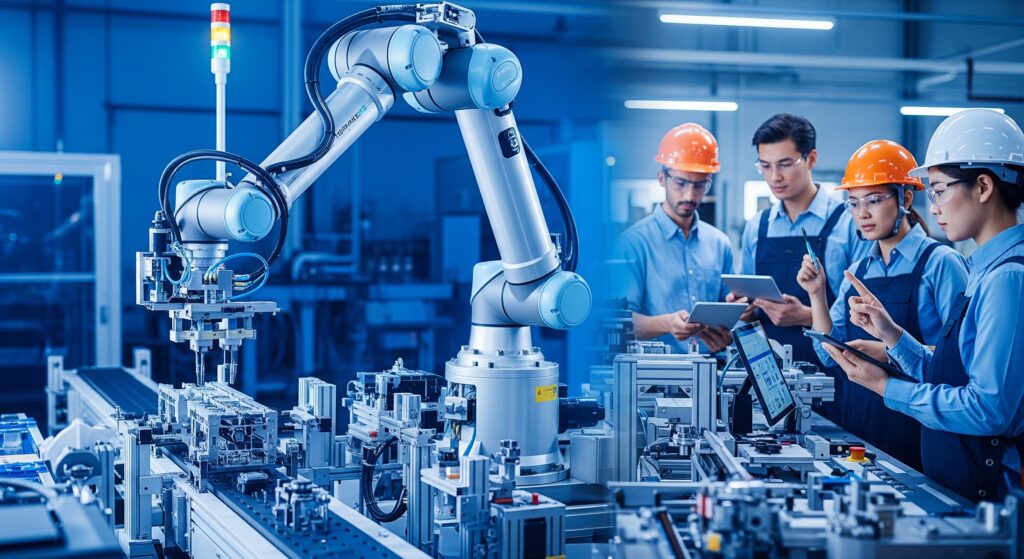
Robotics powered by AI algorithms manage assembly lines with precision. In aerospace, Boeing deploys AI robotic systems for drilling and fastening, reducing errors and increasing safety. Predictive analytics ensures equipment is serviced before breakdowns, minimizing costly interruptions.
Healthcare and Medical Innovation
AI-Driven Automation, The healthcare sector has seen dramatic improvements thanks to AI automation. Radiology departments use AI image recognition tools to detect diseases like cancer earlier and with higher accuracy than manual reviews. Chatbots handle patient intake, reducing administrative burden and improving response times.
Pharmaceutical companies deploy AI-powered drug discovery automation systems to test molecular combinations virtually. This accelerated the development of COVID-19 vaccines and continues to advance treatments for rare diseases. Hospitals use AI-driven scheduling systems to allocate resources more effectively, ensuring that operating rooms and doctors’ time are used efficiently.
Finance and Banking
The financial industry thrives on AI automation. Fraud detection systems analyze billions of transactions in real time, detecting suspicious behavior patterns instantly. Robo-advisors automate investment strategies, providing affordable financial planning to millions of clients previously priced out of wealth management.
Banks also employ AI chatbots for customer service, handling everything from password resets to loan inquiries. Risk assessment platforms powered by predictive analytics streamline credit evaluation, making processes faster and more accurate. However, fairness and transparency in these systems remain critical issues to address.
Retail and E-Commerce
E-commerce giants like Amazon rely on AI-driven warehouse automation to fulfill millions of orders daily. Robotics guided by machine learning algorithms manage inventory storage and retrieval with unmatched efficiency. Recommendation engines personalize product offerings, driving customer engagement and sales.
Marketing automation powered by AI systems tailors advertisements to individual customer profiles. This results in higher conversion rates while also raising debates about privacy and data ethics. The retail sector illustrates both the immense potential and ethical complexity of AI automation.
Transportation and Logistics
The logistics industry is undergoing radical changes. Companies like UPS and DHL employ AI route optimization systems to minimize delivery times and reduce emissions. Autonomous delivery vehicles and drones promise to further disrupt traditional logistics models.
AI-Driven Automation, Fleet management platforms powered by AI predictive analytics anticipate maintenance needs, reducing breakdowns and improving safety. These innovations also align with sustainability goals by reducing fuel consumption and carbon footprints.
Customer Service and Virtual Assistants
AI-driven chatbots and virtual assistants have revolutionized customer service. Unlike traditional call centers limited by human capacity, AI chat systems manage thousands of interactions simultaneously, providing instant and accurate responses.
Advancements in natural language understanding (NLU) allow these assistants to resolve increasingly complex queries. Voice-activated systems like Alexa, Google Assistant, and Siri have extended automation into everyday life, blurring the line between human interaction and machine intelligence.
Agriculture and Food Production
Farmers are adopting AI-powered drones and robotics to monitor crops, detect diseases, and optimize irrigation systems. These technologies reduce labor shortages and improve yield predictions. Automated harvesting robots pick fruits and vegetables efficiently, addressing seasonal labor shortages.
Food supply chains leverage AI automation platforms to manage storage and transportation. By predicting spoilage and optimizing routes, businesses reduce waste and ensure fresher products reach consumers. Such applications are crucial for feeding a global population that is expected to surpass 9 billion by 2050.
Future Outlook: Responsible AI-Driven Automation
The future of AI automation is both exciting and uncertain. While its potential for efficiency, personalization, and innovation is undeniable, unchecked deployment could deepen inequalities, create security risks, and erode trust in institutions.
AI-Driven Automation, Responsible adoption will require collaboration among governments, businesses, and academia. Regulatory frameworks must ensure transparency and accountability without stifling innovation. Companies should prioritize responsible AI practices, integrating fairness, inclusivity, and sustainability into automation strategies.
Workforce adaptation will be equally critical. Continuous investment in reskilling and upskilling programs will help workers transition into new roles created by the AI economy. As automation with AI evolves, human creativity, empathy, and ethical judgment will remain indispensable.
The coming decade will define whether AI-driven automation becomes a tool for collective progress or a catalyst for division. By addressing its challenges responsibly and maximizing its opportunities, society can ensure that automation enhances rather than diminishes human potential
For more insights, visit the ClayDesk Blog: https://blog.claydesk.com