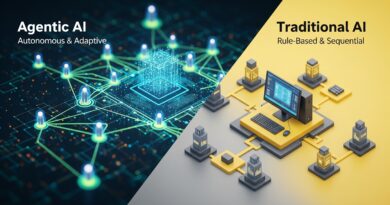

AI vs Chatbots: Understanding the Real Difference and What It Means for Your Business
AI vs Chatbots
In a world buzzing with buzzwords, AI and chatbots often get tossed around like they mean the same thing. But here’s the truth—while they’re related, they are not the same. Confusing these two can lead to poor product decisions, missed customer experience opportunities, and even wasted investment.AI vs Chatbots, That’s why it’s critical to unpack the actual differences between Artificial Intelligence and chatbot technology, how they work individually, and how they can work together to deliver exceptional results.
What Is Artificial Intelligence? A Simple Explanation of AI
Artificial Intelligence, or AI, refers to the capability of machines to simulate human intelligence. Rather than being programmed with fixed instructions, AI systems learn from data, identify patterns, and make decisions. They mimic cognitive functions such as learning, reasoning, and problem-solving.
AI is a broader concept. It includes machine learning algorithms, natural language processing (NLP), deep learning, computer vision, and predictive analytics. These systems improve over time, especially when they are exposed to more data. For example, AI in customer service can analyze thousands of interactions to suggest better responses and improve customer satisfaction rates.
AI can operate independently or serve as the “brain” behind other technologies—such as chatbots. However, not all chatbots are powered by AI, which leads us to our next point.
What Are Chatbots? How Do They Work?
AI vs Chatbots. Chatbots are software applications designed to simulate conversation with human users. They’re typically used in customer support, sales, marketing, and even healthcare. Unlike AI systems that learn and adapt, many chatbots follow pre-defined rules or scripts.
There are two main types of chatbots:
- Rule-Based Chatbots: These are programmed with decision trees. They can only respond to specific commands or phrases.
- AI-Powered Chatbots: These use natural language understanding (NLU) and machine learning to improve responses over time.
For instance, a rule-based chatbot might only respond to “What’s your return policy?” with a static answer. On the other hand, an AI chatbot could handle variations like “Can I send my order back?” or “How do returns work?”
Therefore, while chatbots are a type of conversational interface, they may or may not include AI capabilities.
AI vs Chatbots: Breaking Down the Core Differences
AI vs Chatbots. It’s easy to assume they’re interchangeable, especially since AI often powers chatbots. However, the difference lies in their scope, functionality, and adaptability.
1. Scope of Application
AI is not limited to conversations. It’s used in fraud detection, image recognition, voice assistants, recommendation systems, and more. Chatbots, in contrast, are primarily used to simulate human-like conversations.
2. Learning Ability
AI systems can learn from data and get smarter over time. This learning allows them to respond more accurately and make better decisions. Traditional chatbots, however, are limited to what they were programmed to say.
3. Flexibility
AI can adapt. It can handle ambiguous inputs, process natural language, and provide contextual answers. Basic chatbots follow a linear, rule-based path and cannot deviate from their scripts.
4. Cost and Complexity
Developing a custom AI model can be expensive and complex. Chatbots, especially rule-based ones, are more affordable and quicker to deploy. Yet, AI-powered chatbots provide far greater long-term ROI if implemented well.
5. User Experience
AI enhances user engagement by personalizing responses, whereas chatbots often deliver generic, templated replies. With AI, businesses can elevate the customer journey and boost retention rates.
Use Cases: When to Use AI and When to Use Chatbots
AI vs Chatbots. Choosing between AI and chatbots—or using both—depends on the specific needs of your business.
When Chatbots Make Sense
- Small businesses that need automated responses to common queries
- Customer service teams aiming to reduce call volume
- Lead generation tools for capturing basic contact info
- E-commerce platforms offering order status checks or return FAQs
When AI Is the Better Choice
- Complex decision-making processes like fraud analysis or financial modeling
- Personalized experiences like product recommendations
- Predictive customer support, where the system identifies issues before they arise
- Voice assistants and multilingual applications
Using chatbots can be a starting point. However, if your needs grow or customer expectations evolve, incorporating AI becomes a competitive advantage.
AI-Powered Chatbots: The Best of Both Worlds
In today’s digital-first world, combining AI with chatbots creates a smart assistant rather than a static help desk. These bots:
- Understand context and intent
- Handle vague or complex queries
- Continuously improve based on interactions
- Integrate with CRM systems, pulling personalized data
- Support multiple languages through AI translation models
For instance, businesses like Amazon and Google use AI chatbots to handle millions of customer interactions. They can detect tone, learn from history, and even escalate tickets when necessary—all without human involvement.
Moreover, AI-driven chatbots increase engagement rates and reduce churn because they feel more human, helpful, and less frustrating.
Challenges and Limitations of AI and Chatbots
AI vs Chatbots. Despite their potential, both AI and chatbots come with limitations.
Chatbot Limitations
- Cannot handle unexpected or off-script questions
- Limited language support
- Poor scalability in complex environments
- Frustrating user experiences when not well-designed
AI Limitations
- Expensive and resource-intensive to train
- Requires large volumes of clean data
- Potential for bias in decision-making
- Ongoing maintenance is critical for effectiveness
While chatbots are easier to implement, they may limit long-term functionality. AI offers deeper insights and smarter interactions, but only when done right.
The Future of AI and Chatbots: What’s Next?
AI vs Chatbots. We’re moving toward conversational AI platforms that go beyond basic automation. These systems can understand sentiment, remember preferences, and deliver proactive solutions. They’ll become central to digital customer experience strategies.
With the rise of Generative AI, chatbots will soon create responses that are more dynamic, contextual, and persuasive. Imagine a bot writing a custom product description or an empathetic response during a complaint—all in real-time.
Additionally, AI will make voice-based interactions more intuitive, paving the way for voice commerce and hands-free support across industries.
How to Choose: AI, Chatbots, or Both?
Here are some guiding questions:
- What’s your budget and timeline?
- Do you need basic automation or contextual understanding?
- How complex are your user interactions?
- Can you support ongoing AI training and monitoring?
If you’re a startup, starting with a rule-based chatbot might suffice. As you scale, you can transition to an AI-powered solution. Enterprises, on the other hand, should invest in hybrid models that combine the simplicity of chatbots with the intelligence of AI.
Real-World Examples: Success Stories Using AI and Chatbots
H&M uses chatbots to guide customers through outfit selection. But behind the scenes, AI personalizes recommendations based on browsing history.
Bank of America’s virtual assistant Erica uses AI to help customers with transactions, bill payments, and budgeting—all via conversation.
Domino’s Pizza allows customers to place orders through Facebook Messenger using a chatbot. But AI improves the experience by remembering your favorite pizza.
These examples show that when AI and chatbots work together, they deliver not just automation—but also value and satisfaction.
Final Thoughts: AI vs Chatbots Is Not a Battle—It’s a Partnership
AI and chatbots aren’t competitors. They’re part of the same digital transformation journey. While chatbots give your business a voice, AI gives it intelligence. Together, they enable scalable, personalized, and efficient customer communication.
So, instead of choosing between them, explore how they can complement each other. Whether it’s through smarter customer support, dynamic marketing, or enhanced lead conversion, using AI-powered chatbots could be your next big growth move.
For more insights, visit the ClayDesk Blog: https://blog.claydesk.com