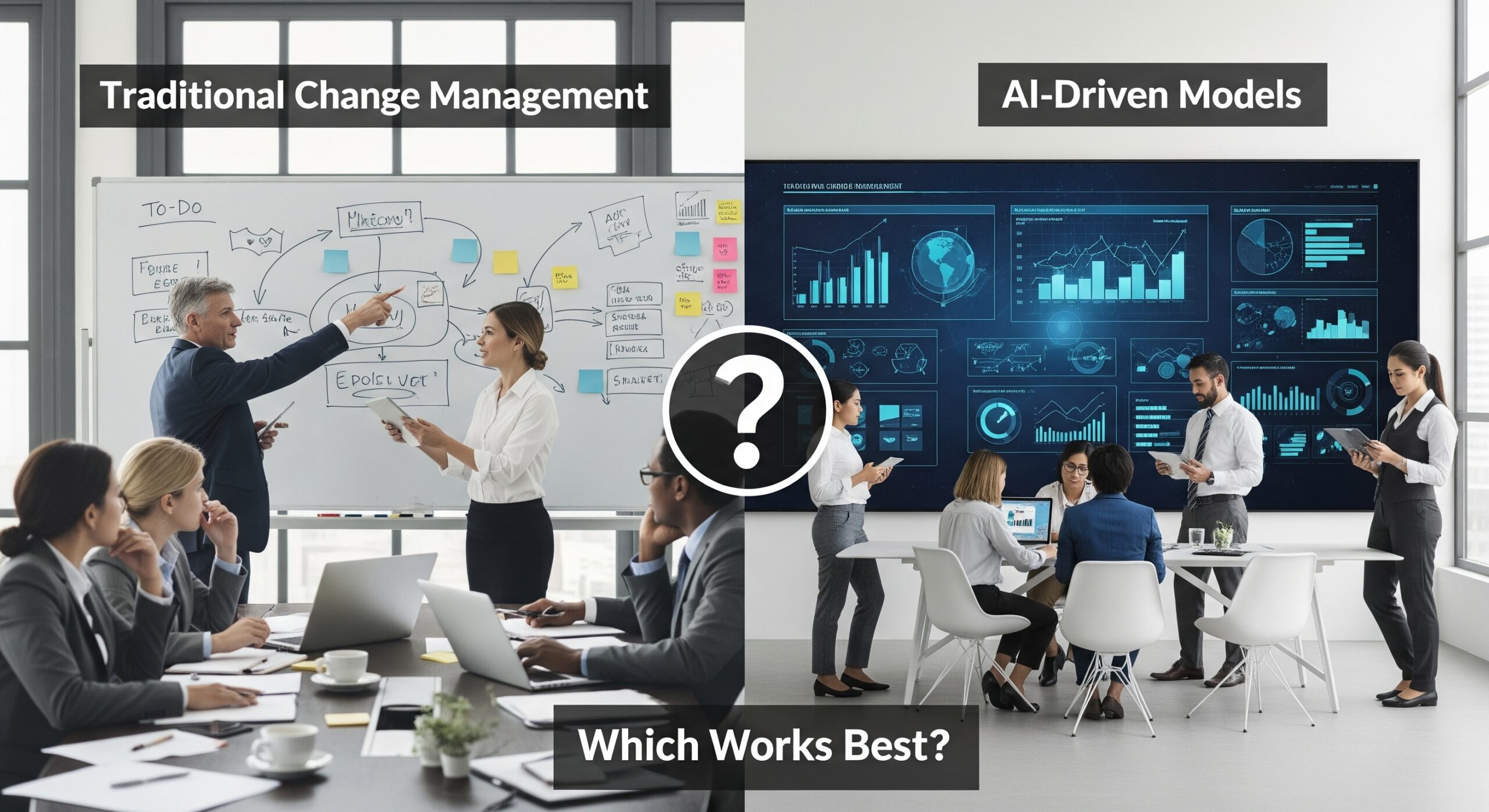
Traditional Change Management vs. AI-Driven Models: Which Works Best?
Introduction
Traditional vs. AI-Driven Management : Change has always been a defining feature of organizational life. Companies evolve in response to shifting markets, new technologies, and evolving customer demands. For most of the twentieth and early twenty-first century, leaders approached transformation through carefully structured frameworks that emphasized human psychology, leadership alignment, and cultural adaptation. Approaches like Lewin’s Three-Step Model, Kotter’s 8-Step Process, and the ADKAR framework became staples in boardrooms, guiding managers through mergers, technological upgrades, and cultural reinventions. These traditional change management models worked by providing structure, emphasizing communication, and ensuring employees felt part of the journey.
However, the world has entered a new era. Advances in artificial intelligence (AI) and machine learning are transforming how organizations can design, implement, and measure change. AI-driven tools provide real-time analytics, predictive modeling, and personalized support for employees. Instead of relying on intuition or post-project surveys, leaders can now see resistance emerging in real time, understand exactly where adoption is lagging, and automate key aspects of transformation.
This contrast raises an important question: Are traditional models enough in today’s fast-changing world, or do AI-driven approaches represent the future of organizational change?
The debate is not just academic. A global bank implementing blockchain-based payment systems, a hospital transitioning to electronic health records, or a retail giant shifting to AI-driven supply chains all face the same dilemma. Should they stick with tried-and-tested frameworks rooted in psychology and leadership? Or should they embrace data-driven, AI-enabled methods that promise speed and precision?
This article explores the issue in depth. It begins with a comprehensive overview of traditional models of change management, highlighting their strengths and limitations. It then examines the emerging world of AI-driven change management, illustrating how predictive analytics, automation, and digital tools reshape the discipline. A comparative analysis follows, highlighting where each approach succeeds and where it falls short. The discussion then turns to the future of hybrid approaches, exploring how traditional wisdom and AI-driven capabilities can complement one another. Finally, the article reflects on ethical challenges and leadership responsibilities, concluding with guidance for organizations navigating this transformation.
By the end, it becomes clear that this is not a question of which approach is universally “better,” but rather how traditional and AI-driven models can be integrated. Change is not slowing down, and the organizations that thrive will be those that understand the strengths of both perspectives.
Traditional Models of Change Management
Traditional vs. AI-Driven Management : Traditional change management has deep roots in organizational psychology and sociology. These models are designed to help leaders structure transitions, reduce uncertainty, and build trust. Although they predate today’s digital realities, they remain influential in shaping how managers think about guiding employees through disruption.
Lewin’s Three-Step Model
Kurt Lewin, often referred to as the father of social psychology, introduced a simple yet profound framework in the 1940s. His **three-step model—Unfreeze, Change, Refreeze—**captures the essence of human adaptation.
The first stage, Unfreeze, involves preparing individuals and organizations to let go of old practices. This often means challenging assumptions and explaining why change is necessary. The Change stage introduces new systems, behaviors, or structures. Finally, the Refreeze stage stabilizes these changes, embedding them into culture and policy so they become “the way we do things.”
Lewin’s model remains popular because of its clarity. For instance, when a university implements a new learning management system, leaders often begin with awareness campaigns (unfreeze), roll out training programs (change), and then institutionalize the platform as standard practice (refreeze).
However, critics argue that Lewin’s model assumes stability after change. In today’s world of continuous transformation, there is rarely time to “refreeze.” Digital disruption, shifting regulations, and evolving customer expectations mean that organizations are always in motion. The three-step model, while useful, may oversimplify modern realities.
Kotter’s 8-Step Process
John Kotter expanded on Lewin’s insights in the 1990s, offering a more detailed framework. His 8-Step Process for Leading Change emphasizes urgency, vision, communication, and consolidation.
The steps include:
- Creating urgency to motivate stakeholders.
- Building a guiding coalition of influential leaders.
- Developing a clear vision and strategy.
- Communicating the vision effectively.
- Empowering employees to act.
- Generating short-term wins to build momentum.
- Consolidating gains and driving more change.
- Anchoring new approaches in the culture.
Kotter’s model has been applied widely in large-scale transformations. A global telecommunications company, for instance, used it to restructure operations during deregulation, carefully building coalitions and celebrating early successes to sustain morale.
Yet Kotter’s approach can be slow and linear, a drawback in industries where change cycles occur within months, not years. In addition, its reliance on formal leadership structures may underplay the importance of grassroots influence in today’s collaborative workplaces.
ADKAR Model
The ADKAR framework, developed by Prosci, shifts the focus from organizations to individuals. Its acronym stands for Awareness, Desire, Knowledge, Ability, and Reinforcement—the five stages employees must experience for successful change.
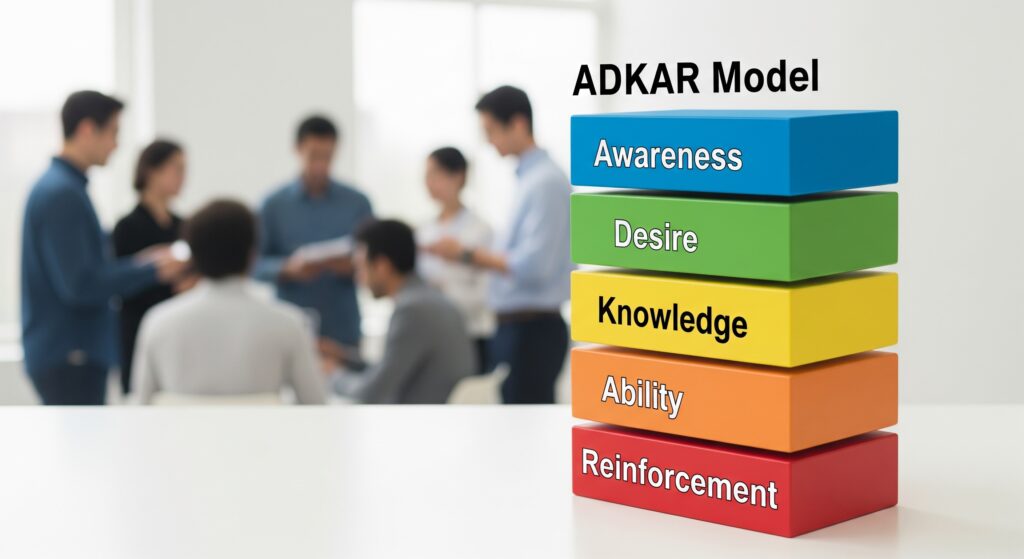
Unlike Lewin and Kotter, ADKAR emphasizes personal readiness. For example, a hospital adopting new patient management software would need to ensure staff are aware of the reasons for change, motivated to participate, trained in necessary skills, capable of applying them, and reinforced with support to prevent relapse.
ADKAR’s strength lies in its recognition that organizational change is the sum of individual changes. However, it can be resource-intensive, requiring tailored interventions for different groups. In large organizations, ensuring every employee receives personalized support can be a challenge.
McKinsey 7-S Framework
Developed by McKinsey consultants, the 7-S Framework emphasizes organizational alignment. It identifies seven interconnected elements: strategy, structure, systems, shared values, style, staff, and skills. Successful change requires harmony among all seven.
For example, a financial services firm moving toward digital banking must not only introduce new systems but also align strategy, restructure teams, retrain staff, and reinforce shared values around innovation.
The model’s holistic nature makes it powerful for diagnosing misalignments. However, it is more a diagnostic tool than a step-by-step change process, and its abstract nature can make it difficult to apply without expert facilitation.
Bridges’ Transition Model
William Bridges introduced a model focusing on the emotional journey of individuals. Unlike process-driven frameworks, it emphasizes the psychological transitions people undergo:
- Ending, Losing, and Letting Go – employees grapple with loss.
- The Neutral Zone – uncertainty and confusion dominate.
- The New Beginning – commitment and acceptance emerge.
A government agency shifting to remote work might see employees mourn lost routines (ending), struggle with new digital tools (neutral zone), and eventually embrace flexibility (new beginning).
Bridges’ model highlights empathy, acknowledging that change is not just structural but deeply personal. Its limitation lies in the absence of practical steps for implementation, making it best when paired with other frameworks.
Strengths and Weaknesses of Traditional Models
Traditional models offer clarity, structure, and human empathy. They acknowledge the psychological dimensions of change and provide managers with roadmaps for guiding employees. However, they often assume linearity, stability, and homogeneity—assumptions increasingly challenged in today’s dynamic, data-rich environments.
AI-Driven Models of Change Management
Traditional vs. AI-Driven Management : Artificial intelligence introduces an entirely new paradigm. Instead of relying solely on human observation and intuition, organizations can leverage vast datasets, predictive models, and automation to drive transformation. AI-driven models shift change management from art to science, enhancing precision while raising new challenges.
Predictive Analytics and Resistance Detection
One of AI’s most powerful contributions is predictive analytics. By analyzing employee behavior, engagement surveys, email sentiment, and collaboration data, AI can identify teams or individuals likely to resist change.
For example, a multinational bank implementing blockchain-based systems used AI to detect declining morale in one branch. By intervening early with targeted training and support, leaders reduced turnover and accelerated adoption.
This predictive capability surpasses traditional surveys, which often lag behind reality. Instead of reacting to resistance after it becomes entrenched, leaders can act proactively.
Personalized Learning and Support
AI enables personalized learning journeys. Adaptive training platforms adjust content to each employee’s role, skill level, and learning pace. A data analyst might receive advanced tutorials, while a customer service representative gets simplified modules.
Chatbots powered by natural language processing (NLP) provide round-the-clock support, answering FAQs and guiding employees through new processes. This reduces reliance on overburdened HR and IT departments.
In a technology firm adopting cloud platforms, AI-driven training reduced adoption time by 40% compared to traditional workshops.
Real-Time Feedback and Agile Adjustments
Unlike traditional post-implementation reviews, AI enables real-time feedback loops. Tools analyze employee sentiment across collaboration platforms, providing instant insights into morale and adoption rates.
If a healthcare provider rolling out electronic health records sees negative sentiment in a particular unit, leaders can deploy additional support before problems spread. This agility ensures smoother transitions.
Automation of Change Logistics
AI automates many logistical aspects of change management, from scheduling training sessions to sending reminders and tracking completion rates. This frees leaders to focus on strategic communication and trust-building.
For instance, a retail giant automating reminders for digital training reduced administrative overhead by 25%, allowing managers to focus on coaching employees.
Digital Twins and Simulation
Perhaps the most advanced use of AI is the creation of digital twins—virtual replicas of organizational systems. Leaders can simulate changes, predicting impacts on workflows, finances, and employee behavior before real-world rollout.
A manufacturing firm used digital twins to test automation on a virtual assembly line. By anticipating bottlenecks, it saved millions in failed experiments and downtime.
Strengths and Weaknesses of AI-Driven Models
AI-driven models bring speed, scalability, and precision. They allow leaders to anticipate problems, personalize interventions, and adapt continuously. However, they also raise challenges:
- Lack of empathy: AI cannot replicate human trust-building.
- Privacy concerns: Employees may feel surveilled.
- Bias in data: Algorithms can reinforce inequalities.
- Complexity: Implementation requires infrastructure and investment.
Comparative Analysis
When comparing traditional and AI-driven models, it becomes clear that each excels in different areas.
Traditional models shine in empathy and communication. They recognize the psychological journey employees undergo and provide leaders with step-by-step guidance. However, they are often slow, rigid, and reactive, ill-suited for fast-paced industries.
AI-driven models, by contrast, offer real-time insights, scalability, and proactive interventions. They excel at identifying resistance early, tailoring support, and monitoring adoption continuously. Yet they risk alienating employees if over-reliant on surveillance and cannot replace the human connection that inspires trust.
Consider two organizations undergoing transformation. A manufacturing company adopting lean processes may find Kotter’s people-centered approach effective, as union trust is essential. A technology company shifting to cloud-first infrastructure might benefit more from AI-driven analytics that identify bottlenecks across global offices.
The most compelling evidence comes from hybrid approaches. A U.S. hospital system implementing EHRs combined Bridges’ empathy-driven communication with AI sentiment analysis, achieving higher adoption rates than either method alone.
Future Hybrid Approaches and Ethical Concerns
The future of change management lies not in choosing one model over another, but in integrating both. Hybrid approaches combine the structure and empathy of traditional models with the data-driven precision of AI tools.
For example, leaders might use Kotter’s steps to build urgency, coalitions, and cultural reinforcement, while deploying AI dashboards to monitor resistance and NLP chatbots to provide personalized support. This combination ensures both human trust and technological agility.
However, hybrid approaches raise ethical questions. Leaders must ensure:
- Privacy: Employee data should be used responsibly, with clear consent.
- Transparency: Employees must understand how AI tools collect and analyze information.
- Bias mitigation: Algorithms should be audited to avoid discrimination.
- Trust: Human leaders must remain visible, empathetic, and accountable.
As AI becomes more integrated, organizations risk treating change as purely technical. The danger lies in forgetting that change remains fundamentally human. Algorithms can guide strategy, but it is leaders who inspire, reassure, and embody the values that employees need during uncertainty.
Conclusion
Traditional vs. AI-Driven Management : So, which works best: traditional change management or AI-driven models? The answer is neither in isolation. Traditional frameworks like Lewin’s model, Kotter’s steps, ADKAR, McKinsey’s 7-S, and Bridges’ transitions provide timeless lessons in empathy, communication, and cultural alignment. AI-driven tools bring speed, foresight, and scalability to environments too dynamic for linear methods.
The future lies in hybrid integration. Organizations that thrive will combine traditional wisdom with technological innovation, ensuring change is both human-centered and data-informed. Leaders must embrace AI tools to remain agile, but they must also embody the trust, empathy, and vision that no algorithm can provide.
Change is accelerating. The companies that succeed will not ask whether to choose tradition or AI, but how to blend them seamlessly to guide employees with both heart and intelligence.essential for organizational resilience and success.
For more insights, visit the ClayDesk Blog: https://blog.claydesk.com